Ally Schweitzer
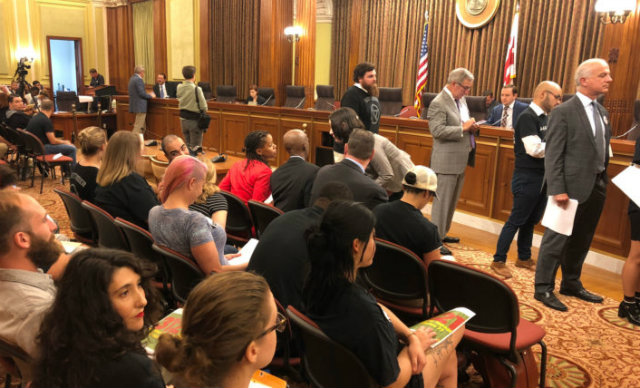 More than 250 witnesses signed up to testify on a bill to repeal Initiative 77, many of them restaurant and bar workers. (Ally Schweitzer / WAMU)
Inside a packed hearing room at the Wilson Building on Monday, dozens of D.C. bar and restaurant workers made one thing clear: They don’t want a raise.
At least not one mandated by the city. That was the apparent consensus among many workers who signed up to testify on a bill to repeal Initiative 77, the ballot measure that passed with 56 percent of the vote in June. The referendum gradually phases out the subminimum wage employers are permitted to pay workers who earn tips.
Among the 250 witnesses who signed up to testify was a stream of restaurant workers, owners and others in the industry who say the initiative would close businesses and imperil their livelihoods, though they were countered by economists, labor activists and a few workers who said the tipped-wage system is inherently unfair.
Early in the proceedings, Council member Charles Allen (D-Ward 6) suggested that Initiative 77 — or at least the version voters approved three months ago — isn’t likely to survive.
“There are seven council members who put their name on a repeal,” Allen said. “It takes seven to pass something. So I feel fairly confident in saying 77 is going to be repealed.”
That would be welcome news to Luis Valle, a restaurant worker who lives in Virginia. In his testimony, he told Council members his parents are immigrants from Peru who rose to the middle class through tipped work. He fears that if Initiative 77 is implemented, menu prices will rise, customers will stop tipping, and he’ll be forced to get a second job to support his family.
“This is going to hurt us,” Valle said.
Other workers cried, one saying her life had been put on hold while legislators decide what to do about the ballot measure, which goes into effect Oct. 9, barring intervention from the council.
Though some witnesses noted the inherent risks of testifying against repeal, saying workers fear retaliation from coworkers and bosses. Others described Council members’ efforts to repeal the vote “undemocratic.”
“The hypocrisy is so thick you could cut it with a knife,” said D.C. Shadow Sen. Michael Brown. He said he voted against Initiative 77, but he chastised council members for supporting a repeal of a democratic vote. “There’s a sacred principle here at stake, and it must be honored.”
Council member Mary Cheh (D-Ward 3) pointed out that workers’ testimony, emotionally charged though it may be, is “speculative” and counters research that has shown largely positive effects on workers from minimum-wage increases.
Testimony from Initiative 77 supporters ranged from passionate to measured, with some saying they’re open to a compromise, including giving business owners more time to adjust to rising labor costs. Cheh, the lone council member who openly supported Initiative 77 before the June primary, has expressed support for a similar approach.
“I think we can do this,” said Matthew Hanson of D.C. Working Families, which supports Initiative 77. “I think the real question should be, how do we phase this in? On what timeline — so we can respect the will of voters and give restaurants a reasonable amount of time to adjust?”
The initiative, as passed, gradually raises the minimum wage employers have to pay tipped workers, increasing it by $1.50 each year until it reaches $15 in 2025. (The current tipped wage is $3.89.) At that point, the two-tiered wage system would be eliminated, so D.C. would be on par with the country’s eight single-wage states.
An analyst with the Economic Policy Institute, a union-backed think tank, testified on his recent paper that shows mostly positive effects from “one fair wage” policies in California and Washington State. But he was rebutted by Yesim Sayin Taylor, director of the business-backed D.C. Policy Center, who said Cooper’s analysis “fails to meet standard tests of reliability.”
Council members are expected to vote on the repeal bill in early October. Chairman Phil Mendelson — who openly opposes Initiative 77 — has said he would introduce emergency legislation to block implementation if he can rally “no” votes from at least nine lawmakers.
But Council member Elissa Silverman (D-At Large) signaled that last night’s testimony may sway some lawmakers who haven’t made up their minds.
“Just because seven people signed onto an introduced [repeal] bill doesn’t mean that there’s seven votes,” Silverman said.
Previously:
Here Are The Big Issues The D.C. Council Plans To Tackle When It Returns
Members Of Congress Are Sticking Their Noses In Initiative 77 Battle
Seven Councilmembers Co-Introduce Bill To Repeal Tipped Minimum Wage Ballot Initiative
D.C. Voters Approve Initiative 77, Ballot Measure That Eliminates Tipped Wage
This story was originally published on WAMU.