 Leonard Slatkin returned to the podium of the National Symphony Orchestra, which is now celebrating its 75th anniversary season, last night in the Kennedy Center’s Concert Hall. DCist was there, along with a full audience that actually did not consist only of people over 50.
Most of us were there, not only to welcome back Maestro Slatkin, but to hear the first of the superstar soloists appearing with the NSO during its big season, violinist Itzhak Perlman. The veteran performer, born in 1945 in Israel, may be nearing the end of his career, but his charisma has not diminished, if some of his technical strengths have waned slightly. He played the Concerto for Violin and Orchestra, op. 14, by one of our favorite American composers, Samuel Barber. It was the young man’s first full concerto, completed in 1939, when he was only 29.
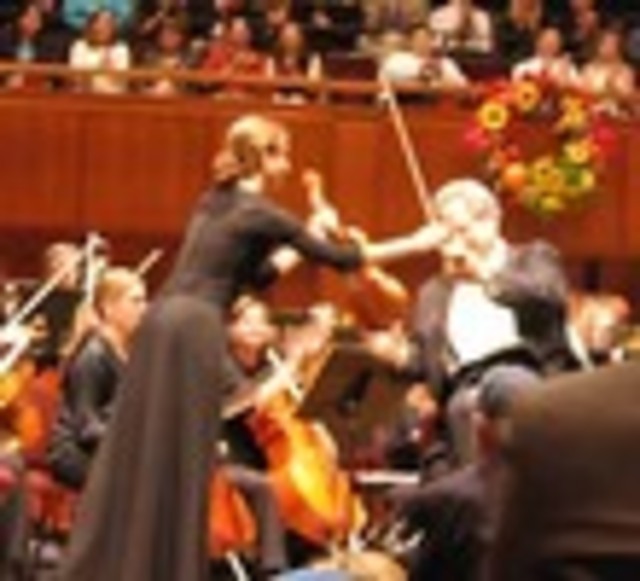
Walking to his seat with the help of leg braces and crutches (incredibly, Perlman’s bout with polio as a child has left him without the use of his legs) to a warm ovation, Perlman accepted the violin that Slatkin had carried in for him. Crouching over the instrument that seemed so tiny in his thick, enormous hands, Perlman launched into the concerto’s first movement, a soaring, radiant performance that captured the happy tone of Barber’s music.
The slow second movement was a feast of tragic melody, marred slightly by minor intonation problems, in the oboes and occasionally in Perlman’s playing. All of the surging Romantic power of the first two movements, perhaps a bit soupy, was wiped away by the frenetic energy of the striking final movement, marked Presto in moto perpetuo. With its shifting meters and Stravinskyesque syncopations, negotiated expertly by the orchestra and Perlman alike, this performance was everything we expected from Perlman’s appearance, and it was a perfect end to the concert’s first half.