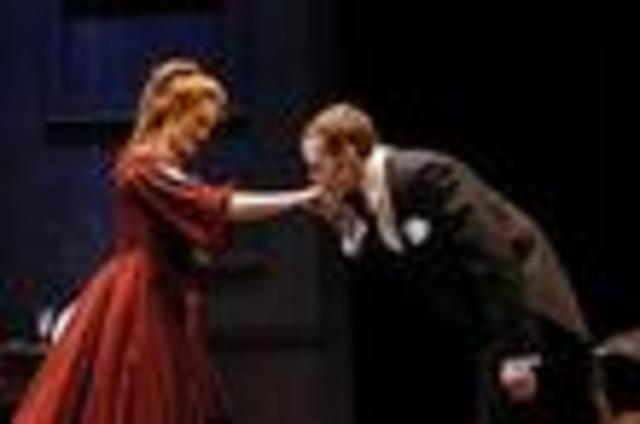
 Boy meets courtesan. Families disapprove. Tuberculosis gets in the way.
The tale may border on predictable. But Neil Bartlett’s Camille, making its American debut at the Round House Theatre in Bethesda, in the tradition of the many adaptions which came before it, proves that it’s not always about a complex plot, if you know how to tell a story right.
The play is based on the allegedly-autobiographical novel by Alexandre Dumas fils, (son of that Three Musketeers guy), and has since proven the inspiration for a Garbo film of the same name, the ever-present opera La Traviata and, arguably, the exercise in excess known as Moulin Rouge.
While the novel is marked by a tragic, sentimental beauty, Bartlett’s take is almost jarring in its coarse modernity. The title character swears with the best of them; sex scenes are raw and charged; and characters are stripped of any 19th-century airs you might be expecting. This proves largely effective throughout the play, though the knowing way characters address the audience, particularly near the beginning and end of the work, can be a bit much.
The staging is lovely, mostly taking place in an elegant drawing room angled in such a way to put some distance between the characters and the audience. No detail is spared, from costumes to set accents, and scene transitions are marked by words projected onto the stage, seemingly invoking chapter titles.