At DCist, we have danced all around the Paul Klee show, Klee and America, at the Phillips Collection. Our classical music man Charles discussed Klee and Gunther Schuller, and we tempted you with the show here, here, and here. It’s finally time to turn a critical eye on Klee’s work itself.
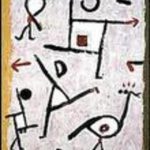
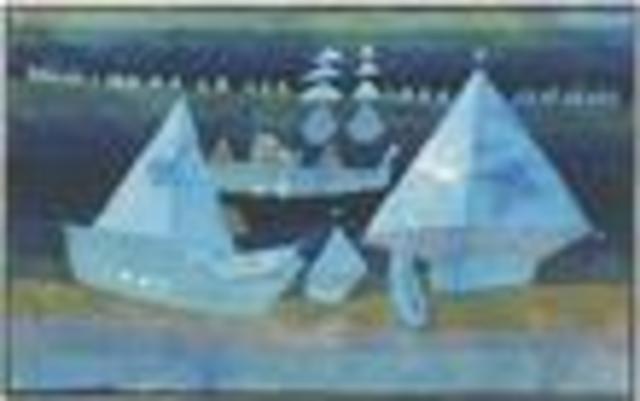
 Paul Klee could be one of history’s most schizophrenic painters. When he shows up, one might say, sober for work, does his aesthetic stretches, and carries his Jekyll palette, his paintings evoke the Kokopelli Chili Company logo (which looks something like this) or some alien hieroglyphics that unfold visually for specific, compelling reasons. But when Klee shows up with his Hyde brush, his work often emerges as dime-a-dozen, surrealist play, even cute and trivial.
But it’s the venue here that might be the most interesting component of the show. According to the exhibit wall texts, Klee and America thought little of each other. Klee held no desire to visit America, even as the Nazis denounced his art as degenerate. Americans showed little interest in purchasing Klee’s work, to the extent that only two private American collections boasted his work by the end of the 1920’s, the decade when Klee’s work debuted in America. A critic at the New York Herald called him a “strange meteor from Switzerland.” (He fled to Switzerland in 1933, after the Nazis removed him from his teaching post at Düsseldorf Academy.)
So why is Klee on exhibit at an American museum when he fought to remain a European artist? When he never even set foot in America?