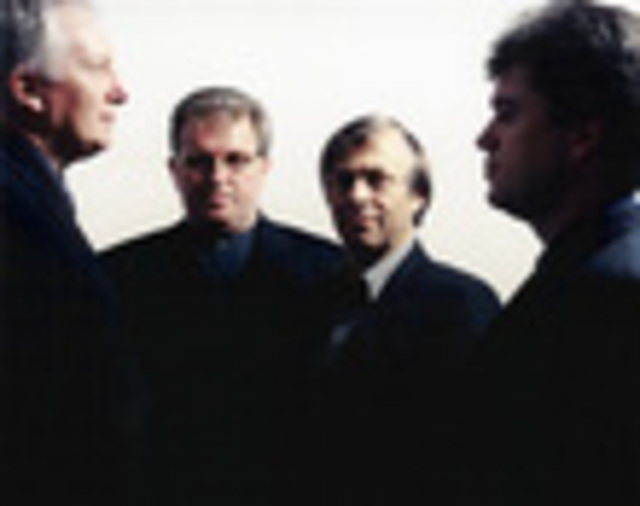
 The Freer Gallery of Art hosts an eclectic and sporadic series of free concerts, often in tandem with relevant exhibits. To cap off the fine exhibit of early Bible manuscripts at the Sackler Gallery (reviewed here last month), the museum hosted one of the best vocal groups in the world, the Hilliard Ensemble, last night. The all-male British quartet brought a program called Arkhangelos, modern and older pieces in the Catholic and Orthodox traditions, to the Meyer Auditorium.
The Hilliards are known primarily for their exquisite recordings and live performances of Renaissance and medieval polyphony, as in their acclaimed 2006 CD of music by Nicolas Gombert. However, they also commission and perform new and experimental music (as in Officium, their popular recording with saxophonist Jan Garbarek), and that was the focus of this thorny and challenging concert.
The program takes its name, Arkhangelos, from a piece of that title by English composer Ivan Moody (b. 1964), at the opening of the concert’s second half. The text is a 6th-century poem by Agathius Scholasticus, about how meditating on an icon of St. Michael impacts a person’s mind. The musical setting is appropriately inward and mysterious, mostly with very pretty sounds. It goes well with a piece near it in the program, Arvo Pärt’s Most Holy Mother of God, an ecstatic litany on the words “Holy Mother of God, save us” premiered by the Hilliard Ensemble in 2005. The texture of this piece alternates between layering of slow melodic lines and a harried homorhythmic mantra-like section, which grows from softness through an arching crescendo.
The group also had fine moments in another work composed for them, Alexander Raskatov’s Praise, a setting of five liturgical texts from the Liturgy of St. John Chrysostom. The very dissonant logic of the first piece, Hymn of the Cherubim, meant that at crucial points, unisons solemnly resolved to seconds, as Raskatov used grating dissonance, piled up in succession, to propel the piece through rocking swells. The opposite effect is achieved in the second piece, The Lord’s Prayer, where at certain points the four voices end up on the same note in four different octaves. Gentle Light contrasts the declamation of the text in highest and lowest voices with an ison (drone) of ostinato with glissandi in the middle voices. The fourth movement’s speech rhythms were, frankly, a little silly, but the minimalistic repetition of the pulsing fifth movement was exciting, speeding up like a whirling dervish to a sudden end.
Hilliard Ensemble, photo by Friedrun Reinhold