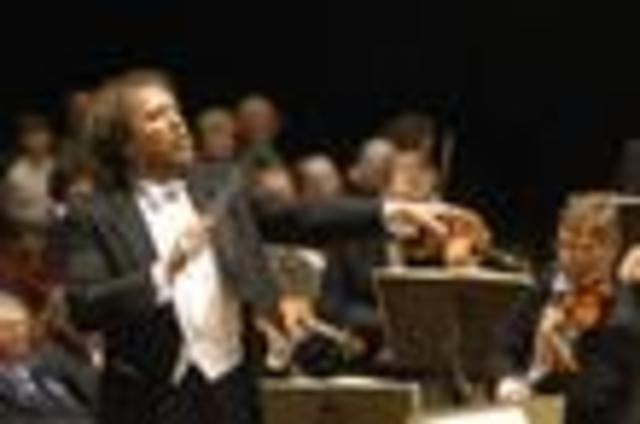
 A trip out to Fairfax requires some justification, which the concerts hosted by the George Mason University Center for the Arts occasionally provide. This was the case Saturday night, when that venue distinguished itself as the only local stop for the current U.S. tour of the orchestra of the Leipzig Gewandhaus (recently in Chicago and Boston, but also in smaller places like Schenectady). That venerable ensemble, founded in 1781, is one of the oldest orchestras in the world. The musicians, who have always played at a high technical level, are making news again because of their new conductor, Riccardo Chailly, who now holds the podium occupied at various times by Kurt Masur, Bruno Walter, Wilhelm Furtwängler, Carl Reinecke, and Felix Mendelssohn. How embarrassing that the hall at GMU was not sold out, although the audience that filled perhaps three-fourths of the modest house was certainly appreciative.
Of the two programs the Gewandhausorchester has on offer for this tour, its first with Chailly, it was the one devoted largely to Richard Strauss that was selected for Fairfax (the other features Mahler’s fifth symphony, as well as Mahler’s arrangement of Schumann’s first symphony, to go along with the orchestra’s most recent recording of Mahler’s Schumann arrangements). The evening opened with an excellent rendition of Strauss’s tone poem Don Juan, op. 20, a brash and difficult work that tells the story of the legendary seducer of women and his eventual downfall.
The hero’s loud, daring theme arrested the ears immediately, because of the orchestra’s excellent unanimity of sound. All sections sounded strong and well-proportioned, especially the clarion brass (except for a few misplaced notes buried down somewhere in the horn section) in Straussian swells, which Chailly often cued as if his hand were crushing an orange. Particularly fine solo work came from concertmaster Frank-Michael Erben, whose music represents Donna Anna: in its first appearance, Strauss leans heavily on sounds quite similar to the Venusberg music in Wagner’s Tannhäuser, with the violin surrounded by trills, harp, bells. At the moment of Don Juan’s greatest exaltation, the score abruptly cuts to silence, to give way to the mysterious music heralding the hero’s undoing.