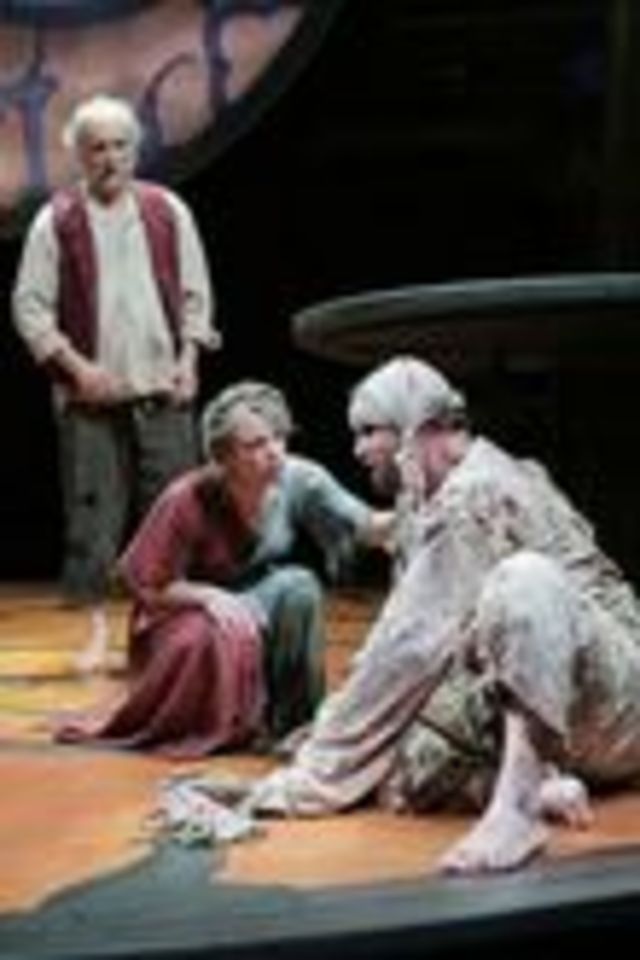
 I skipped the season finale of Lost the other night in favor of another supernatural tale of attractive people haunted by their pasts who just want to get off the damn island. The Folger’s latest staging of The Tempest is a light, spritely, fleet-footed thing of a play, apropos for a show about forgiveness and renewal and the casting off of old follies. Like the shipwreck that opens Act I, it’s forceful and bewildering and seemingly over so fast you walk out unsure whether or not you’ve just seen it at all; its weightlessness is the best and worst thing about it.
The last time we saw The Tempest ‘round these parts, in a Shakespeare Theatre production, it had gone all Miss Saigon on us. They had a very real looking ship onstage and Ariel spent the show in a flying harness. I remember being so impressed by the actor’s ability to sing for two hours while inverted like Gene Simmons that I can no longer remember whether his performance was any good.
Fortunately, this version of Shakespeare’s farewell to the “rough magic” of playwriting is more a garage-band affair. Save for some Eye-of-Sauron-style surround-sound-and-fury when Ariel (a headset-miked Marybeth Frtizky) has to scare the shipwrecked visitors into behaving themselves, this is modest production by Folger standards.
Tony Cisek’s set is comprised by six discs of various heights and sizes, one of which serves as the backdrop behind which Ariel spends the show imprisoned (a problem, since we can’t see her). Within these circles is a pattern suggestive of gearworks or the innards of a clock; a sly emblem of the fact that Prospero, the deposed ruler-cum-sorcerer at the center of the tale, is a man whose powers both of wizardry and of judgment, while remarkable, have their limitations.
And make no mistake about it — this is “The Prospero Show,” for better or for worse. Michael Rudko is never less than watchable in the part, though his performance does emphasize the benevolent, paternal aspect of the character, at the expense of the bitterness against which the exiled wizard struggles. His brother, Antonio, overthrew him as Duke of Milan and left him and his daughter to die at sea. Is he not at least a little bit, you know, pissed, even after 12 years?