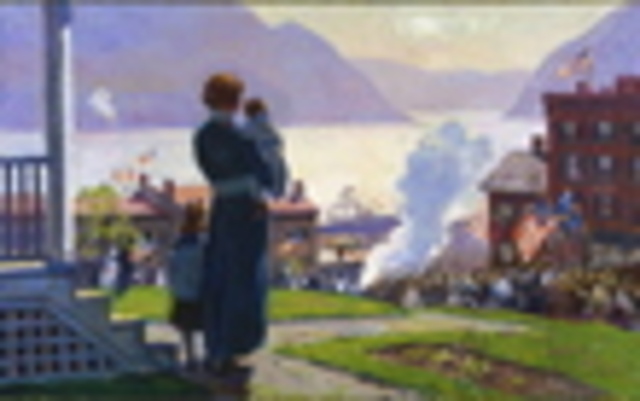
 Gifford Beal’s On the Hudson at Newburgh was hidden beneath another painting for most of the 20th century. Really.
Childe Hassam once told an interviewer, “I believe the thoroughfares of the great French metropolis are not one whit more interesting than the streets of New York.” And our painting is just as good, too!, he didn’t say, but he may as well have: Upon his return from study in Paris in 1889, Hassam, along with like-minded fellow American painters like John Henry Twachtman, William Meritt Chase, J. Alden Weir and others, spent the next few decades establishing a distinctly domestic strain of Impressionist painting, informed by the work of the French masters, but apart from it.
While these painters adopted the techniques pioneered by the likes of Monet, Degas, and Pissaro — working outdoors, using color even to depict shadow, staccato brushstrokes, alla prima (no-sketch) painting — they broke with the French by expressing a more emotional connection to their subjects. The Yanks preferred more muted hues, and the diffuse sunlight of dawn or dusk to the intense light of midday. Equally significant was their choice to depict “the intimate landscape of familiar places,” as Phillips Collection Assistant Curator Susan Behrends Franks puts it — in other words, quiet, local scenes were deemed as worthy of a canvas as the cliffs and waterfalls preferred by the French masters.
American Impressionism: Paintings from the Phillips Collection showcases 72 prime examples of just what the name says, from this Saturday through Sept. 16. While most of the pieces on view will be familiar to regular Phillips visitors, you haven’t seen them all: Hassam’s watercolor Drydock Gloucester has never been displayed before, says Frank, while three featured Maurice Pendergrast watercolors are getting only their second showing. Other rarely-seen works include a pair of Twachtman pastels as well as pastels from Paul Dougherty, Arthur Wilder, and Henry Cooke White that Frank says haven’t been shown in decades.