 Relatively few critics can resist the temptation to invoke natural imagery when describing the instrumental epics of Pelican. This should come as no surprise, as the Chicago quartet creates songs that truly move at a glacial pace — songs that sometimes spend as long as 20 minutes building up and tearing down a single melody. Over the past few years, the band has increasingly come to favor a more restrained approach, allowing the subtleties of guitarists Laurent Lebec and Trevor de Brauw’s complex interplay to come to the fore. This has earned them a number of comparisons to 90s post-rock icons like Slint and Mogwai as well as more contemporary acts like crescendo-obsessed Texans Explosions in the Sky. A quick listen to Pelican’s latest, City of Echoes, confirms these comparisons; over the course of eight tracks and 42 minutes (a downright lean runtime for Pelican) the record explores ideas of urban space through the use of shifting textures, scales and dynamics. One track on the album even consists almost entirely of two dueling acoustic guitar lines. So perhaps, you can see how we’ve managed to forget one important fact over the last few years: Pelican is a metal band.
Pelican, however, was more than happy to remind us of this fact during their set at the Black Cat on Saturday night. From the moment Lebec jacked his Les Paul into an ominous Sunn amp head, the audience was hit with a relentless wash of distorted, downtuned guitars. “This set is dedicated to Earth, masters of the slow jam,” de Brauw said before starting the set, tipping his hat to the Seattle-based drone-metal pioneers who opened with a series of drawn-out, intentionally repetitive instrumentals.
Pelican, by way of contrast, managed to create a drone of textural noise without ever sounding tedious. On tracks like “Last Day of Winter,” from 2005’s The Fire in Our Throats Will Beckon the Thaw, Lebec stuck close to the upper registers, cutting through the thick crunch to provide the audience with a melodic lifeline in a sea of major chords. Meanwhile, de Brauw’s equally dynamic fretwork elicited some serious headbanging from a cadre of fans stage right. As expected, the band’s oft-maligned drummer, Larry Herweg, stuck to his usual tricks — the guy seems to know only two rhythms: slow and steady and double-bass blast beat — the only weak link in a well-oiled machine. Luckily, his brother, bassist Bryan Herweg, more than picked up the slack, his fingers moving spider-like up and down the fretboard, laying down thick bass lines that reverberated through the room like a didgeridoo. The band closed their set with the 20-minute epic “March Into the Sea,” embracing their dualistic nature with both spiraling guitar dogfights and extended harmonic interludes. We probably won’t forget that Pelican is a metal band again anytime soon: the ringing in our ears won’t let us.
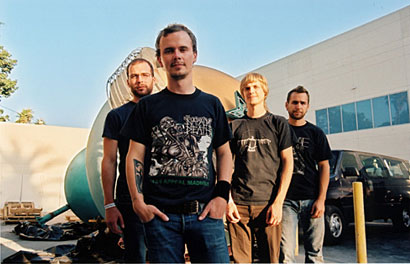
Photo from Pelican’s website