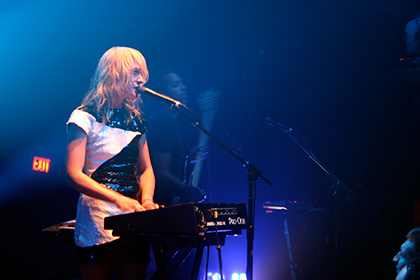
 The morning after seeing Toronto’s Metric, I had a brief water-cooler conversation with a co-worker who had caught the band the last time they rolled through town. “I’ve always been surprised how quickly that band blew up,” he said. “It seems like they got huge almost overnight.” I nodded in agreement, having seen them fill a 1,200-capacity club the night prior. After giving the matter some thought, however, I realized that Metric’s rise to the top of the indie pops really isn’t that surprising at all. At this point, cynics might be tempted to point to the band’s willingness to license their songs for commercial use (including multiple plays on the post-O.C. tastemaker Grey’s Anatomy) or their close affiliation with other popular Canadian acts (Broken Social Scene, Stars). While there’s no denying that these sorts of tactics have helped expose the band to a wider audience, to accuse Metric of “selling out” is to ignore one fundamental truth: Metric makes—and has always made—extremely accessible pop music. From Emily Haines’ clever yet straightforward lyrics to the band’s catchy, hook-laden arrangements, Metric has always sounded like a band destined for bigger things.
Crystal Castles, on the other hand, seem destined to live out their days in relative, albeit hip, obscurity. The young Canadian duo has everything going for them in terms of credibility—a deal with French electronic imprint Kitsuné, effusive write-ups from Pitchfork and remixes of everyone from Bloc Party to Ed Banger rabble-rouser Uffie—but could stand to work on their performance. Multi-instrumentalist Ethan Fawn was the first to take the stage, building up layers of chirps and beeps until they sounded like a choir of R2 units. This noise eventually gave way to a blunt drum machine beat, some gurgling 8-bit synths and an auxiliary rhythm pounded out on a set of live drums. At this point, single-named vocalist Alice emerged from the side of the stage, grabbed the microphone and started yelling like it was the old 9:30 Club. After the first verse, she started removing her clothing layer-by-layer, until she had stripped down to a T-shirt and skirt. She then proceeded to grab one of the two strobe lights sitting at the front of the stage (the band’s only lighting) and brandished it like a weapon, shining it into the eyes of the front row.
These sorts of theatrics usually draw an audience into a performance, but Alice’s second-rate Karen O posturing only underlined the struggle between her confrontational vocals and the musical backdrop that she often drowned out. While Crystal Castles’ compositions were consistently engaging—think Ladytron but noisier or a more spastic version of the Faint—Alice’s hardcore-style vocals and upstaging antics did little to build upon the band’s arrangements. Crystal Castles certainly have a lot of potential, but for now they’re just putting the “clash” in electroclash.
Photos by Mehan Jayasuriya