 If you really must attend a holiday concert, make it something musicologically interesting. In what has become an annual tradition (see the 2005 and 2006 installments), the Folger Consort is presenting the most appealing and satisfying Christmas concert in the city. More than just a concert, it is a staged production of the Second Shepherds’ Play, an English mystery play from the Towneley cycle.
Director Mary Hall Surface began by modernizing the play’s Middle English text, while keeping enough of its archaic vocabulary to preserve something of the original’s flavor. Unlike many medieval dramas, especially those in Latin, there is no music recorded in the manuscript, but it makes sense to imagine the work performed with some kind of music, instrumental or vocal. Robert Eisenstein of the Folger Consort worked his usual magic to select a varied program of historical music perfectly suited to the play, including a short set introducing each of the two acts, instrumental music to accompany action, and songs sung by the characters.
The story is hardly unfamiliar: when Jesus was born, an angel appeared to shepherds in the fields outside Bethlehem, telling them the good news that a savior has been born, to go to the manger and see him. But who were those shepherds? What were they doing when the angel appeared to them? How did they talk? What sort of lives did they live? The ingenuity of the mystery play is that the author or authors, anonymous in this case, answer those questions, filling out the story with fleshier characters, and make these somewhat mysterious people from the Gospel just like their viewers.
The whole first act is given over to the three poor shepherds and their daily complaints. The gentry lord their wealth over them. The youngest shepherd, a wily servant, even complains about his masters. They worry about their flock when the untrustworthy Mak appears on the moors, suspected of stealing. Always cunning, Mak plots a way to steal one of the sheep, which his wife, the shrewish Gill, tries to pass off as her newest-born (the lamb in the cradle foreshadowing the birth at Bethlehem). Once we feel as if we know these characters and see them like ourselves, suddenly the English shepherds intersect with the Biblical story and become the shepherds of Bethlehem.
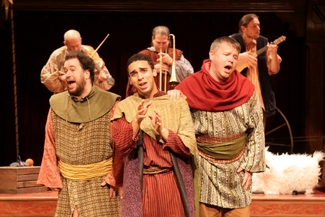
Photo of Second Shepherds’ Play by Carol Pratt (Folger Shakespeare Library, 2007)