 In this newest exhibit at the Phillips Collection, the museum shows off 120 works acquired in the last decade, including work by 28 artists new to the Phillips. Director Jay Gates, along with Chief Curator Eliza Rathbone, explained at the press preview on Monday that these recent acquisitions continue the tradition of Founder Duncan Phillips, who expressly wished for the museum’s collection not to be stable or static, but for his successors to maintain the integrity of the collection with a respect for the past, and “a commitment to the discourse of living artists.”
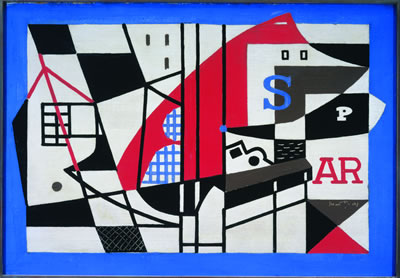
The exhibit spans several rooms, and includes work that represents many of art history’s key movements, including work by such recognizable masters as Stuart Davis, with his 1932 Spar (pictured above) serving as an iconic example of his graphic and geometric style, as well as German Expressionist Lionel Feininger, with four watercolors showcasing the post-WW2 work he created after his move to the United States. Other classic highlights include work by Color Field artist Helen Frankenthaler and Abstract Expressionist Hans Hoffman, whose 1949 Two Studies for Sculpture and 1955 One Afternoon sit side-by-side, allowing viewers to examine differences between two works separated by six years of art-making.
Throughout Degas to Diebenkorn, the curators pair works with similar content, giving visitors with less knowledge of art history an invitation to explore the art work on familiar ground. For example, Ansel Adams’ high contrast Ice on Ellery Lake, Sierra Nevada is placed alongside two Milton Avery woodcuts of birds and the sea. Similarly, in one of the exhibit’s most memorable rooms, Weegee (Arthur Felig)’s black and white photograph of four away-facing, top-hat-wearing men hangs above Jacques-Henri Lartigue’s contrasting print of four forward-facing women, all adorned with enormous hats of their own, complete with feathers, flowers, and poofs. This room, filled completely with black and white photography, is a surprising addition to the Phillips Collection, and marks the museum’s recent effort to collect photographic work.