Martin Austermuhle
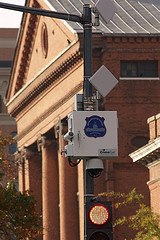 We mentioned it earlier today, but it’s worth discussing further — the District’s crime cameras.
According to the Post, a study by D.C. Police Chief Cathy Lanier released to the D.C. Council argues that the city’s 73 crime cameras have helped lower violent crime in the areas where they have been installed:
The report, prepared for the D.C. Council by the office of Police Chief Cathy L. Lanier, says violent crime increased about 1 percent citywide last year. But, it says, violent crime decreased 19 percent within 250 feet of each of the cameras, which the city began installing in August 2006. Property crimes increased 5 percent overall last year but 2 percent in the camera areas, the report says.
Of course, many of the cameras critics don’t see it that way. To them, the cameras haven’t succeeded in decreasing crime more than they have in simply changing the places where it’s likely to occur. Moreover, they argue, the $4 million spent so far could better be used on more traditional crime-fighting techniques. The ongoing debate reminds us of something we wrote in 2006, just as the Council had agreed to fund the installation of the cameras as part of a late-summer crime emergency:
We’ve never much been fans of the idea, and now we have to concede this much — the cameras are here to stay. Though part of emergency legislation that expires in mid-October, the cameras will likely be made a permanent staple of the District’s urban landscape. Why? Because crime or not, the cameras obey only the logic of the politicians who voted for them. If crime falls, whether or not the direct product of the cameras, the law-and-order contingent on the D.C. Council will claim that they were right all along — cameras do deter crime. If crime remains the same or even spikes, that same crowd will call for more and more cameras. Whichever way the wind blows, we should get get used to the cameras.
And so it shouldn’t be much of a shock that the MPD plans on installing 50 more cameras over the next two years, as well as ramping up resources so they can monitor them around the clock. Once the new cameras are installed and Lanier can demonstrate a drop in crime in their vicinity, she’ll push for even more to be installed. The end result? At this rate, an almost fully surveilled city by the time Mayor Adrian Fenty has to run for re-election.
What are your thoughts? Are the cameras a necessary evil, or an excessive intrusion? Do they represent the next generation of crime fighting, or a foolish misuse of scarce resources?
Picture snapped by takomabibelot