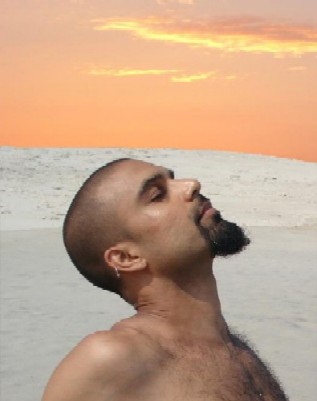
 I first encountered local writer/activist Hawah last fall at a Subcontinental Drift open mic night. He was performing as a member of ShantiSalaam, a collective of local South Asian American artists who toured 11 cities in India and Pakistan in late 2006/early 2007 to promote tolerance among South Asians of different religious backgrounds. The group’s performance used music, spoken word, and audience interaction to address issues of intolerance between individuals and the institutional forces that encourage this mindset. Hawah’s writing not only deals with these issues, but also broader global issues dealing with conflict, prejudice, poverty and social justice.
On first glance, Hawah may come across as just another “new agey” type, but even a slight scratch to the surface reveals a man of deep intelligence, passion and commitment to the broader good. In addition to being a published writer of prose and poetry, Hawah’s creativity extends to multiple disciplines including painting, performance art, and music. It is more than just the creative process that drives him, as he also has a strong commitment to affect social change. This makes him a notable member of a small but growing group of local artists who do not see a distinction between artistry and activism.
Hawah, who was born Rajeev Kasat, spent a considerable amount of time in India as a child. Seeing the rampant poverty there informed his world view and drove him to work on issues of social justice. As a member of Americorps, he worked as a community organizer and mentor to elementary school students in D.C.’s poorest neighborhoods. Hawah co-founded his first non-profit community organization in 2000, and in 2001 he received a fellowship that allowed him to travel to Geneva, Switzerland and Durban, South Africa, where he worked closely with the United Nations and the World Conference Against Racism and Discrimination. More recently, he has taught in D.C.’s public schools, lectured on college campuses, and is also a certified yoga instructor, a practice he uses as vehicle for change. DCist interviewed Hawah to get some insight into his creative process and his views on this city.