
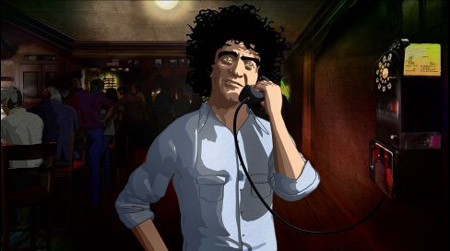
 Chicago 10 is a thoroughly entertaining look at the infamous 1969 trial of the group that came to be known as the Chicago 7 — which is to be expected, as its director, Brett Morgen, previously made a similarly inventive and engaging documentary on legendary movie producer Robert Evans, The Kid Stays in the Picture. The two docs couldn’t be about more different subjects, and Morgen wisely ditches the wink-and-a-nod ironies of his previous film in favor of a more serious tone here. But the director is a consummate entertainer, and in the animated segments scripted from the courtroom transcripts, it’s hard for the material to not come off as an extremely well-executed Court TV re-enactment, rather than the historical document the material requires.
The facts of the case have been covered in enough other films and history books now to (hopefully) be already familiar ground to most. In 1968, a group of activists, including Abbie Hoffman and Jerry Rubin, organized a youth festival in Chicago’s Lincoln park to coincide with the Democratic Convention, which could then turn into a roving protest. Chicago Mayor Richard Daley, not about to let a bunch of hippies, yippies, and other assorted counterculture groups put a black mark on his city’s hosting of the convention, had the festival and marches monitored, regulated, and blocked by riot gear-clad officers. The result was, somewhat predictably, a violent and bloody confrontation. Hoffman, Rubin, and six others were indicted on charges of inciting the riots.
The trial was heavy on drama and entertainment value all on its own, with the defendants openly defying a judge who was well known to lack impartiality, and a roll of witnesses that included Arlo Guthrie, Norman Mailer, Jesse Jackson, and Allen Ginsburg, among others. It’s a shame that there were no cameras to record the daily theater of the absurd that went on in that courtroom. Morgen sidesteps that issue by animating these segments, and having actors voice the parts in the transcripts. In theory, it sounds like a great idea; in practice, it’s problematic.