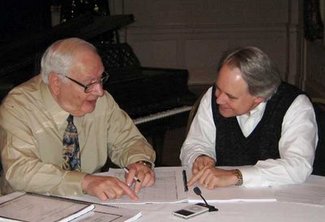
 Dominick Argento and J. Reilly Lewis, photo courtesy of Cathedral Choral Society Dominick Argento and J. Reilly Lewis, photo courtesy of Cathedral Choral Society |
Washington National Cathedral celebrated its 100th anniversary last year, on September 29, the date that the cornerstone was laid in 1907. To celebrate the centenary, the Cathedral Choral Society presented a commissioned work on Sunday afternoon, a new oratorio by American composer Dominick Argento. Having recently watched his wife die of an undiagnosable neurological ailment and also having turned 80 himself, Argento thought he had retired from composition. The persistence of CCS’s director, J. Reilly Lewis, however, combined with a gentle suggestion by Argento’s late wife to lead him to fulfill the Cathedral commission with Evensong: Of Love and Angels, dedicated to the memory of Carolyn Bailey Argento.
Vespers (Evensong) is a venerable and living tradition in the Episcopalian church, and that is the background of this new oratorio, which follows the basic outline of the service in the Book of Common Prayer. The scriptural reading that provides the basis of Evensong is taken from the fifth chapter of the Gospel of John. Argento focuses on the sick and infirm crowds huddled around the pool of Bethsaida (Bethesda), waiting for the miraculous cure associated with that place in Jerusalem. According to a legend, an angel would descend to the place and stir up the water, after which the first person to step into the water would be healed. The hope of a miraculous cure for a terminal illness is what appealed to Argento, according to his note in the program (Argento’s wife spent her final days in a Bethesda Rehabilitation Center in Minnesota).
The liturgical context is rich, to be sure, of which only the surface has been scratched in Evensong. Musically, Argento’s score was in the largely neoclassical style we have come to expect from him, with dissonances ranging from lush to acerbic almost always resolving to triads and perfect intervals. A striking main theme pervades the work, with its first three notes based on Argento’s late wife’s initials, C-B-A (that is, down a minor second and up a minor seventh). A series of chords based on the three-note motif (C major, B major, A major) is heard many times, too, and actually concludes the final movement, hovering in the distance over a D pedal point, denying a final sense of resolution.