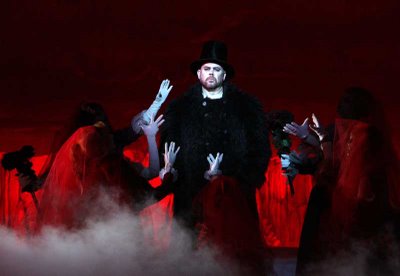
 Alan Held and the Zombie Brides in The Flying Dutchman, Washington National Opera, 2008, photo by Karin Cooper Alan Held and the Zombie Brides in The Flying Dutchman, Washington National Opera, 2008, photo by Karin Cooper |
On Saturday night Washington National Opera returned to the stage of the Kennedy Center Opera House, with a production of Richard Wagner’s Der Fliegende Holländer. Wagner wrote his own libretto, drawing on a folk legend retold in a Heinrich Heine novella. The Flying Dutchman is a ghost ship, and its unnamed Dutch captain is condemned, because of a deal with the devil, to sail the ship for eternity. He is allowed to disembark once every seven years to search for a woman whose self-sacrificing love can redeem him.
This production is a revival of the production from New York City Opera, directed by Stephen Lawless. A skewed rectangle of wood frames the raked stage, and backdrops help situate the action, most effectively with rising and falling images that give the impression of watching a ship’s deck pitching on the waves. Lawless has either not read the libretto closely or he has attempted to recast the story, but not in a way that shocks or surprises: it just makes the opera a bit of a muddle.
Lawless has taken two details from the story and tried to explain them with his staging, magnifying them far out of proportion as a result. First, the angel that arranges the opportunity for the Dutchman to seek a wife on land every seven years is represented by a clumsy wooden bird wing gliding through the stage (sets designed by Giles Cadle). To add to the confusion, the wing first appears with the red light that heralds the Dutchman’s approach, long before he has even mentioned the angel. The libretto does specify that the Dutchman’s ship has “blood‑red sails and black masts,” although we never see the sails, just the red light, even emanating from inside Daland’s little treasure box (lighting design by Joan Sullivan-Genthe). Second, instead of a spectral crew, the Dutchman is attended by seven zombie brides, some of them with their breasts partially exposed, not a confusion of the story with Duke Bluebeard’s Castle, but “the fate awaiting those who break their vow to me.” Otherwise, the costumes were mostly generic, except for the Dutchman, who in a stovepipe hat and extravagant fur coat (the libretto specifies only “black clothing,” twice) often looked like he was in a gorilla suit (costume design by Ingeborg Bernerth).