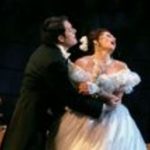
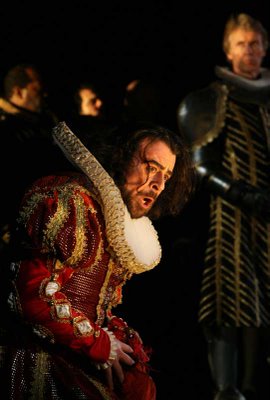
 Carlos Álvarez as Rigoletto, Washington National Opera, 2008, photo by Karin Cooper Carlos Álvarez as Rigoletto, Washington National Opera, 2008, photo by Karin Cooper |
Rigoletto, premiered at Venice’s Teatro La Fenice in 1851, is generally named as the first instance of Giuseppe Verdi’s mature compositional voice. In terms of dramatic cohesion and musical sophistication, it is light years ahead of Ernani, an opera from 1844 with a remarkably similar background (the same librettist, Francesco Maria Piave, adapted a play by Victor Hugo for both operas, and both were premiered in the same theater). Somewhere along the way, Verdi became a confident, ground-breaking opera composer, and Rigoletto (1851), which opened on Saturday night at Washington National Opera, marks that transition.
Part of that success was that Verdi was more dramatically shrewd, and his improving track record allowed him to dominate the creative relationship with Piave. Another component was that the story taken from Victor Hugo’s play Le Roi s’amuse, was less complicated and yielded more operatic possibilities. Still, the play was regarded as dangerously revolutionary, meaning that Verdi had to mollify the imperial censors in Venice by recasting the noble philanderer as the Duke of Mantua, rather than a king, but it was not Hugo’s title character who most interested Verdi and Piave. It was the court jester, Rigoletto, who became the center of this opera.
Rigoletto is an audience favorite, and the company has lately been reviving it about every eight or nine years (the last productions were in 1999 and 1991). It does require a serious cast, which for the most part this one is, beginning with baritone Carlos Álvarez, who was vocally puissant and dramatically gripping in the title role. The character is a study in contradictions, which is part of what makes him so endlessly fascinating: Hugo said that the jester was so protective of his daughter because he himself was such an evil man and knew evil intimately. Piave’s libretto and Verdi’s score present him also as a flawed but vulnerable father, in spite of his faults, and in any case, we cannot possibly sympathize with the callous Duke and his amoral court.