 Generally speaking, most indie rock artists try not to draw too much attention to the insecurities, struggles and personal histories that drive their work, lest their private lives become better known than their music. Until recently, it was impossible to read a write-up of Chan Marshall without encountering condescending (and arguably sexist) adjectives like “delicate” and just try digging up a piece on Daniel Johnston or Anton Newcombe that doesn’t rely on mental illness for its hook.
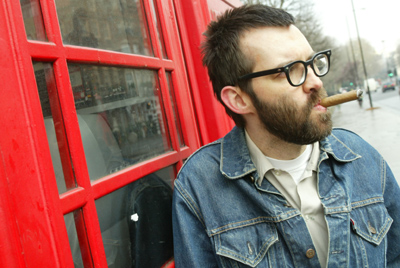
You would think that Mark Oliver Everett, aka “E,” the only constant in the ever-changing lineup that comprises the Eels, would be especially sensitive to this — after all, he’s currently under contract to Vagrant Records, a label that’s synonymous with a certain three-letter epithet that also starts with the letter “e”. Despite this fact, E has always been open about the fact that he mines his tragic family history for songwriting material, an act that seems to serve as a form of therapy for the bespectacled frontman.
As if this fact wasn’t already obvious, E chose to further highlight the source of his inspiration through his choice of an opening act for Saturday night’s show at Chinatown’s Sixth and I Historic Synagogue. The show began not with a musical opening act but rather, with a film: the BBC special “Parallel Worlds, Paralell Lives,” a documentary on E’s ongoing struggle to come to terms with his distant relationship with his now deceased father, Hugh Everett III. Everett the senior, a brilliant physicist said to be decades ahead of his time, drank and smoked himself to an early death out of frustration that his advanced theories on quantum mechanics were never understood in his own time. What’s more, he is said to have been a distant father, which has left E — now the last remaining member of his immediate family — to sift through what’s left of a short yet extraordinary life. Now, the Eels are no strangers to less-than-traditional opening acts (one of their previous tours found them preceded by a mime) but this was, admittedly, a bizarre way to open a rock and roll show, by any standards. So what was the point? Misguided artiness? Humor? Self-aggrandizement? Seems to us like it was just good old fashioned honesty.
You see, Mark Oliver Everett has been doing some soul-searching lately. He recently penned a memoir that became a best-seller in the U.K. (it helps that the Eels have managed to transcend “cult band” status over on that side of the pond), Things The Grandchildren Should Know. He also recently released two retrospective collections, chronicling his band’s career highlights, B-sides and imaginative music videos. But that’s not all. As we learned on Saturday night, Everett has also been dwelling on his musical past in front of audiences every night on the band’s latest tour.
If you ask any Eels fan what his or her favorite album is, you’ll invariably be told that it’s either Electro-Shock Blues or Daisies of the Galaxy. The two albums mark Everett’s creative highpoint and together represent one of the best — and most underrated — unified statements of late 90’s indie rock. Where Electro-Shock Blues is oppressively depressing — and rightfully so, having been recorded the year that both Everett’s mother and sister passed away — Daisies is its life-affirming counterpart, the rainbow after the thunderstorm, if you will. While the two albums tend toward emotional extremes, when considered together, they present the listener with a fully-formed portrait of E’s fractured world view. So it’s fitting that E, while sitting in both the literal and figurative spotlight, chose to devote the lion’s share of the night’s set to stripped-down renditions of tracks from those two albums. Given his recalcitrance to play many of these songs in the past, the set felt like an Eels fanboy dream come true.