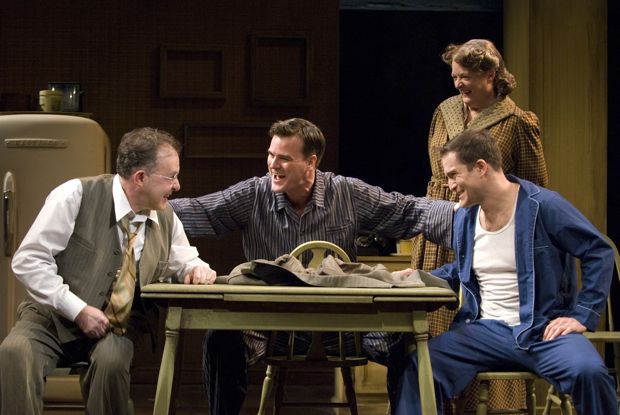
Rick Foucheux, Tim Getman, Nancy Robinette, and Jeremy S. Holm are all smiles in Arena’s Death of a Salesman. Photos by Scott Suchman/courtesy Arena Stage.
Willy Loman is a tired, pitiable, senile man, older than his 60 years. But in the canon of 20th century American drama, he’s the Alpha dog, the big man, the Steve McQueen. He’s become an iconic figure, like Icarus or Hamlet, and lots of people who have never seen Arthur Miller’s defining 1949 Pulitzer-and-Tony-Award-winning Death of a Salesman probably know that to say somebody is “Willy Lomanesque,” is to call him pathetic and defeated, the epitome of self-effacement-as-cowardice rather than generosity.
It’s all unfair to Willy, honestly. He fights like a dog through this thing. He’s got some flaws, sure — his can-do American optimism long ago decayed into self-delusion, and he’s kind of a jerk to his loyal wife, who is even stronger than he knows — but his big problem, famously, is that he’s “liked, but not well-liked.” And, of course, that he’s outlived his usefulness to his employer. [Did Miller mean this as a broader indictment of capitalism itself? Discuss.]
The big selling point of Arena Stage’s handsome, satisfying new Salesman (in rep with Miller’s 1955 A View from the Bridge, the dual anchor for their Arthur Miller Festival) is the casting: As Willy, we have Rick Foucheux, in — oh, how I have waited to be able to type this phrase! — the role he was born to play. That alone would be reason enough to see it. Foucheux, who won a Helen Hayes Award a few years ago for a similar-but-not-the-same part in Studio’s Take Me Out, gets Willy’s misfiring sense of masculinity exactly, heart-wrenchingly right. That aside, in her quiet, controlled performance as Linda, Mrs. Loman, Nancy Robinette comes dangerously close to stealing the play away from him.