DCist’s highly subjective and hardly comprehensive guide to the most interesting movies playing around town in the coming week.
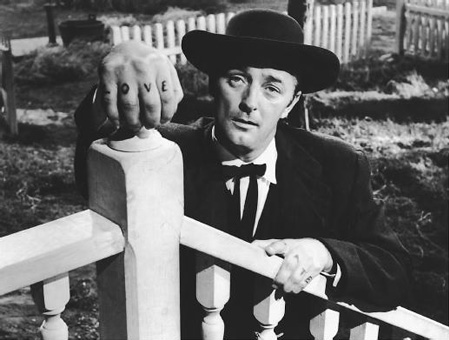
It seems that there have been a lot of film noir picks in this column in recent months, and the AFI’s current Robert Mitchum retrospective isn’t exactly helping us break the habit. This week, though, features the best of the lot, with Mitchum’s chilling turn as a Gospel-spouting murderer who marries a West Virginia widow (the always excellent Shelley Winters), but not out of “love”, no matter what his tattooed knuckles might claim. Winters’ husband, executed for his role in a robbery gone wrong, hid the money before his incarceration, and hinted to his cellmate (Mitchum) where it might be. Mitchum marries the widow in the hopes of figuring out the location of the stash. Mitchum’s coldly calculating killing machine is surely one of the most indelible portraits of undiluted evil; in fact, even if you’ve never seen or heard of the movie, you’re probably familiar with him via those often imitated (and satirized) LOVE and HATE tattoos he sports on his fingers.
The film was a huge failure upon release. On paper, it seemed like a slam-dunk, based on a popular bestseller, and with a cast of stars like Mitchum and Winters, along with the legendary Lillian Gish, and being the directing debut of another acting legend, Charles Laughton. Yet critics panned it, and audiences stayed away. After developing into a cult classic, it’s now gained it’s rightful reputation as one of the finest films of its decade. Laughton (who never directed another film after Hunter‘s failure), along with screenwriter James Agee and cinematographer Stanley Cortez, turned the novel into a masterpiece of offbeat, southern gothic-infused film noir, shot like a German expressionist film. The blend must have been pretty jarring for a mid-1950s Hollywood product, but was truly visionary in retrospect.
View the trailer.
Opens tomorrow at the AFI and plays through next week.
—
One dose of inky cinematic blackness not enough for you this week? Then head over to the Smithsonian’s American Art Museum next week for Orson Welles’ Touch of Evil. The timing is appropriate, since the film features one of the finest performances ever delivered by the recently deceased Charleton Heston — even if he was improbably cast in the role of a Mexican police official. Heston’s Mike Vargas spends the film trying to get to the bottom of a U.S. bombing that originated in Mexico, and in the process discovers a hotbed of dirty dealings all leading to the feet of a crooked cop played by the director himself. Welles uses the camera as inventively as always, not least of all in shooting himself: in the height of his excess-induced corpulence, the camera shoots Welles in close, wide angles that actually accentuate how large he’d become. With heavy lidded eyes, stubble, and a sheen of oily perspiration, the viewer can almost smell the stench of sweaty corruption rising off of him. The film is notable on a couple of counts, not least of which the fact that it casts the Mexican cop as the hero, and the U.S. cop as the baddie, not exactly a typical arrangement for 1950s Hollywood. It’s also one of the few cases in which studio meddling didn’t do much to sully a craftsman’s work; while Welles’ had the film taken away from him in editing (as tragically happened to so many of his movies), and some scenes were even re-shot by another director, even in its original form its greatness is undeniable. The film has been recut multiple times over the years, and next week’s screening is of the 108-minute 1976 version. While not definitively Welles’ vision (none of the cuts are), it’s still a must-see classic in any case.
View the trailer.
Screens on Wednesday at 6:00 p.m. at the McEvoy Audiotorium of the Smithsonian’s American Art Museum. Free.