 Nowhere but the Warehouse can we imagine such a gritty, diverse and inflammatory group exhibit blending so well with its environs. Upon entering End of Nature, one is taken aback by its exhibition statement, which begins, “Have humans become a form of cancer? We certainly behave like one,” and continues by asking, “after the end of nature … will we be alone, just people and the bacterial cultures required to sustain us, or will we manage to keep a few souvenir species alive for company?” Not exactly subtle.
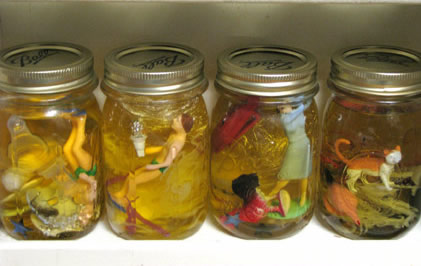
Equally alarming but significantly more intriguing, Renee Shaw’s rows and rows of junk-filled mason jars line the Warehouse’s front display window. In Preserve (pictured above), toys, tampons, fuzz, slime in various colors — all bottled up for preservation — line numerous white shelves viewable from the street. Although quite gross, the installation surprisingly borders on beautiful, and definitely starts the exhibition with a curious note.
Upstairs, the Warehouse’s rough and peeling walls are filled with work by over twenty area artists. Although curator Ruth Trevarrow certainly lacks subtlety in her statement, the artists did not all follow suit. Some pieces, like Deborah Ellis’ nicely watercolored Four Part Ice, employ traditional media and techniques to illustrate a quite matter-of-fact view of the end of nature. Similarly, Linda Byrnes exhibits two delicately rendered but straightforward pencil drawings of empty bird nests, and pairs these more traditional works with sculptural, airy nests created from plastic six-pack holders. While this use of relevant materials is communicative, it’s a bit of a one-note.