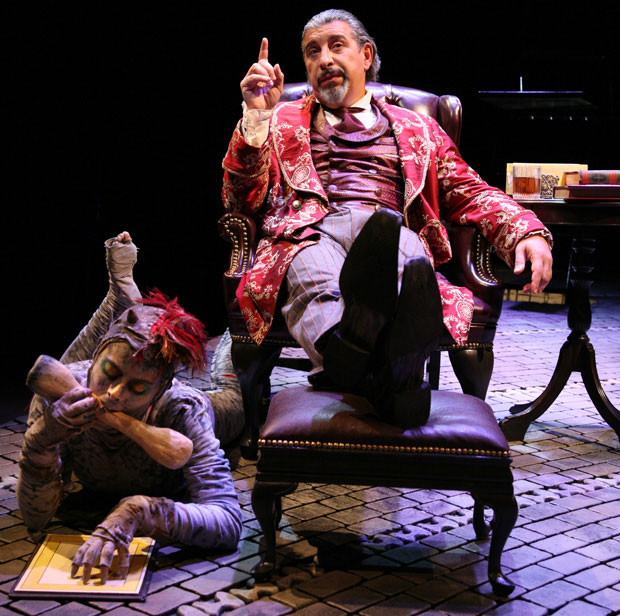
Karen Eleanor Wight and Max McLean get demonic in The Screwtape Letters. Photos by Gerry Goodstein.
Though I had never written anything more easily, I never wrote with less enjoyment . . . though it was easy to twist one’s mind into the diabolical attitude, it was not fun, or not for long. The work into which I had to project myself while I spoke through Screwtape was all dust, grit, thirst, and itch. Every trace of beauty, freshness, and geniality had to be excluded.
— C.S. Lewis, from his preface to The Screwtape Letters (paperback ed.), 1959
Man, if the Vast Right Wing Conspiracy had C. S. Lewis on the payroll these days, we’d all be in trouble — er, worse trouble. Lewis, the World War I vet, Oxford and Cambridge academic, uber-prolific author, and all-around intellectual heavyweight, converted to Christianity in his early 30s. He’s probably most remembered for the hugely popular evangelical Chronicles of Narnia novels he penned chiefly for young readers, but he was equally adept at proselytizing to adults. A clear and elegant thinker who played the English language like a fine instrument, Lewis was and is so good, you’d hardly know you were being preached to.
Exhibit A would be The Screwtape Letters, his epistolic novella wherein one of Hell’s senior demons advises a novice devil, Slubgob, who’s here on Earth among us mortals, making a play for a “patient’s” soul. Originally published in The Guardian beginning in 1941, when German bombs rained on London with numbing regularity, the letters are — depending on your point of view — a brilliant work of fiction or a brilliant work of theology. Either way, the B-word stands. In cataloging precisely (but not, of course, exhaustively) the 1,001 means by which a human endowed with free will might become corrupted, Screwtape elucidates Lewis’s key theme that “the best road to hell is the gradual one.” Or, as Screwtape observes later, “A murder is no better than cards, if cards will do the trick.”