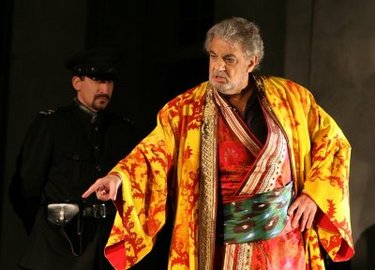
 Plácido Domingo (Bajazet) in Tamerlano, Washington National Opera, 2008 (photo by Karin Cooper) Plácido Domingo (Bajazet) in Tamerlano, Washington National Opera, 2008 (photo by Karin Cooper) |
For a few years, reports have been coming from Europe of major opera houses pairing up with historically informed performance (HIP) ensembles to present Baroque operas. Such residencies combine the staging power of a full-time opera company, as well as major opera singers, with the musical specialization of a well-established early music group and its regular conductor. Washington National Opera experimented with Baroque opera in the previous two decades by staging a couple Handel operas. The company’s new production of Handel’s Tamerlano (see the rehearsal blog) may not exactly reproduce the European model, but it gets many things right.
The Ottoman emperor Bayezid I once boasted that his horse would use the Throne of St. Peter as its manger. The proud sultan’s downfall at the hands of the Tartar emperor Timur Lenk in 1402 has been recounted numerous times, including by Christopher Marlowe (Tamburlaine, 1588) and Jean Racine (Bajazet, 1672). Stories of Bayezid’s humiliation while he was Timur Lenk’s prisoner — Timur used him as a footstool, kept him caged like an animal, made his wife dance naked for his court — and resultant suicide from despair are probably apocryphal, but they make for great drama.
Handel composed Tamerlano, premiered in London in 1724, on a libretto by Nicola Francesco Haym (adapted from Piovene Agostino’s libretto, also used by Vivaldi a few years later in Bajazet). This production uses the 1731 revision of Handel’s score, with significant cuts that reduced the evening to a total of only three and a half hours, with two intermissions. Even so, the unfamiliar opera and the unfamiliar sounds (countertenor David Daniels, theorbos, harpsichord) combined with the length to drive many in Wednesday night’s audience home early. Little matter that even the Metropolitan Opera has had countertenors appear on its stage, that David Daniels is one of the best known countertenors in the world at the moment, that Baroque opera is a craze everywhere, sectors of the Washington audience quickly lost interest. It says more about them than the strength of either the work or this remarkable production.