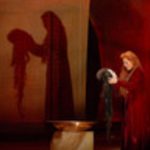
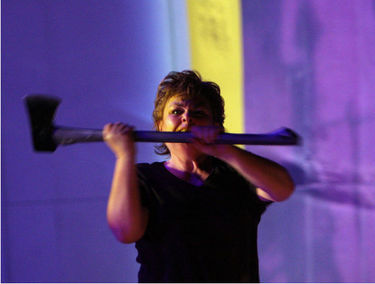
 Susan Bullock as Elektra, Washington National Opera, 2008 (photo by Karin Cooper) Susan Bullock as Elektra, Washington National Opera, 2008 (photo by Karin Cooper) |
Washington National Opera opened its final production of the season on Saturday night, Richard Strauss’s 1909 opera Elektra. This opera is in a sense an extension of the verismo style, just with a much better orchestral score and less vulgar melodies. It takes on ancient stories, from Greek mythology, and shockingly refracts them through the lens of modern psychology. Carl Jung used the story of Electra, of course, to describe the female counterpart of Freud’s Oedipus complex, just a few years after the premiere of Strauss’s opera. Hugo von Hoffmansthal’s libretto for Elektra leaves open many possible motivations for Elektra’s unhinged rage toward her mother, none of them pleasant to contemplate.
Elektra has been abandoned in the house of Agamemnon, who was murdered upon his return from the Trojan War by his wife and her lover. She plots her revenge for her father’s murder, even burying the axe used to kill him, in the hope that she and her brother, Orest, can use it to slay Klytemnästra. This is not the first misfortune to befall the doomed House of Atreus, and it will not be the last. Why is Elektra so devoted to her father, who slew another of his daughters, Iphigenia, to appease Artemis and grant strong winds for the voyage to Troy?
Elijah Moshinksy’s production, revived from the WNO’s last staging of Elektra in 1997, attempts to offer some answers. As directed this time around by David Kneuss, both Klytemnästra and Chrysothemis, Elektra’s sister, are costumed in gowns and jewelry (costumes by Robert Israel). Elektra’s more masculine hair and costumes, a sort of military jacket and pants, play with the dialogue in Elektra and Chrysothemis’s duet. After the sisters discuss the latter’s femininity and desire to be married and have children, Elektra kisses Chrysothemis forcefully. The words associated by Freud with the Elektra complex, which are best avoided in conversation these days, come to mind when we see her wielding that axe, too.