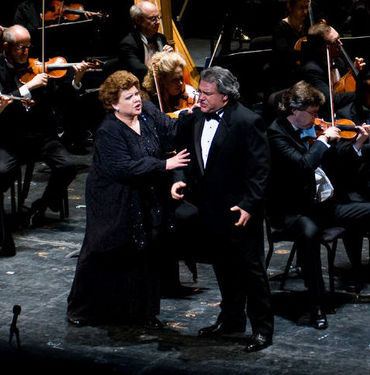
 Dolora Zajick and Salvatore Licitra in Cavalleria Rusticana, Washington National Opera, photo by Leah L. Jones Dolora Zajick and Salvatore Licitra in Cavalleria Rusticana, Washington National Opera, photo by Leah L. Jones |
To cap off its 2007-2008 season, the Washington National Opera is offering a boldly flavored, if hardly unusual digestif, a concert performance of Mascagni’s Cavalleria Rusticana. Shrewdly programmed concert performances of opera, like many of those offered by Washington Concert Opera, are opportunities to perform a relatively unknown works by a well-known composer (Rossini’s Tancredi or Bianca e Falliero) or something that few people in their right mind would ever think of staging (like Moses und Aron or Das Wunder der Heliane).
Mascagni’s over-performed, bite-sized piece of verismo pablum is neither of those things (although even WCO resorted to Cavalleria a few years ago). The initially disappointing sales for these performances seemed to indicate that even the often unadventurous Washington audience had voted it down. The slate of singers, however, had to give anyone pause, as it included two important names in this sort of repertory. The Sunday afternoon performance removed any doubt: anyone who loves great singing, such as we do not hear all that often here in Washington, should find a way to hear the only remaining performance, this Friday night.
There is no point in arguing about the value of the work: those who love it, love it, and vice-versa. If sung and played well, as it was here, its emotionally crude appeal can pack a punch. American mezzo-soprano Dolora Zajick, in her regrettably late company debut, sang as the maligned Santuzza with a voice that was a stunning force of nature. The few times that she sang directly toward me, it was like a torpedo of sound. That vocal bludgeon was deployed only at emotional high points, mixed with a range of vocal qualities, like the lines drawn by a quill, from razor-sharp to thickly inked. Zajick has rightly earned a reputation for this role, as well as even more forceful and demanding ones, like Verdi’s Azucena and Amneris.