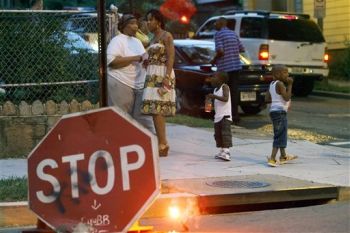
 Residents watch the police checkpoint in D.C.’s Trinidad neighborhood on Saturday, June 7, 2008. (AP Photo/Jose Luis Magana) Residents watch the police checkpoint in D.C.’s Trinidad neighborhood on Saturday, June 7, 2008. (AP Photo/Jose Luis Magana) |
We balked at the initial news that the Metropolitan Police Department planned to throw up barriers and checkpoints in certain D.C. neighborhoods experiencing excessive violent crime. Later, when we learned the details of the first case, the week-long checkpoint that was established in Trinidad, the MPD’s plan appeared to be both constitutionally dubious and potentially not very effective. So it’s with great interest that we read today’s Washington Post editorial lambasting critics of the checkpoints for getting more upset about murky constitutional issues than about high rates of violent crime and murder.
There’s a dispute over whether the operation violated Fourth Amendment protections against unreasonable searches and seizures. There is some merit to the claim that police were using the checkpoints for general law enforcement, which could render them unconstitutional. But city attorneys make a convincing argument that because the program’s goal was the physical safety of roadways, it passes constitutional muster. Indeed, they liken the Trinidad stops to sobriety checkpoints, which have been upheld by the Supreme Court.
Most of us who felt that the checkpoints bore a far too close resemblance to police state tactics would argue in return that all of us want an increased police presence in Trinidad that could ensure the physical safety of the neighborhood’s roadways — just not at the expense of hassling and turning away District residents without probable cause. Well via City Desk, it turns out Chief Cathy Lanier says she actually had a specific reason for putting up the Trinidad checkpoint. D.C. Watch has the recap of her testimony at a D.C. Council hearing on the matter.
Chief Lanier announced for the first time that the stated reasons for instituting a blockade of the Trinidad neighborhood were not the true reasons, or at least not the major reason, behind the cordon. There was another, more important, reason, she told the committee, but she could not reveal what that reason was. If the committee members knew what she knew, she was confident that they would agree with her actions, but she couldn’t tell them what she knew. She had, she said, specific information that there were specific individuals who were going to enter that neighborhood to commit a particular crime. Preventing that crime was the real reason for quarantining Trinidad. No lesser measures — tracking those specific individuals, warning the intended victims of the crime, etc. — would have sufficed to prevent the crime. Only a full-scale lock down of the neighborhood and lockout of other citizens was enough. But councilmembers would have to take her word for it, because she couldn’t tell them anything more.
Of course, that’s not at all the reasoning Lanier gave when the “Neighborhood Safety Zone” initiative was first announced.