DCist’s highly subjective and hardly comprehensive guide to the most interesting movies playing around town in the coming week.
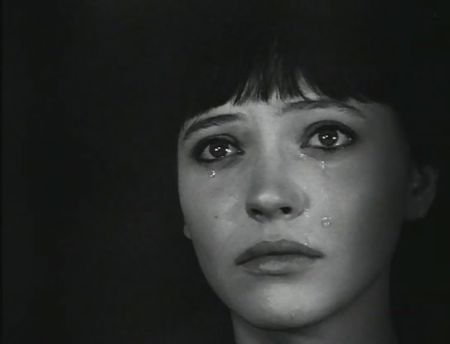
The AFI has returned to it’s regular presenting schedule, which means that their Godard retrospective continues marching on. It’s rather appropriate that My Life to Live is the first film to screen after the documentary festival: Godard infused his fourth feature with a realistic energy that came directly from the cinéma vérité movement that took documentaries as their inspiration. It’s also, in this viewer’s humble opinion, the best film that Godard ever made, a perfect blend of the director’s best qualities; simultaneously playful, inventive, rebellious, confrontational, and brimming over with trenchant social commentary. And, it stars Anna Karina, who we’d be happy to watch reading the Parisian phone book for a couple of hours during her 1960s prime.
Karina plays a wife and mother who abandons her family to become an actress. When things don’t go quite to plan, she drifts into a life of prostitution, and things continue to unravel from there. The film’s subtitle, “A Film in Twelve Scenes”, is a literal description of Godard’s structure. There are exactly twelve scenes, and each one is introduced with a title card describing what we are about to see. It’s one of a number of self-conscious or deliberately unconventional devices used by the director that in many ways pulls us out of the world of the film. As is often the case, Godard wants us to be quite aware that this is a movie; as much as he enjoys his bits of pulp fiction, he’s determined to never make empty entertainment. And the film is as thought provoking in its examination of the conditions that push our lives one way or another as it is engrossing, and even sometimes infuriating.
If you head to Saturday night’s screening, be sure to stick around for a book signing by New Yorker film critic Richard Brody, who will sign copies of his new book, Everything is Cinema: The Working Life of Jean-Luc Godard.
View the (momentarily and marginally NSFW) trailer.
One screening per day from tonight until Sunday at the AFI. Check the schedule for times.
—
Chances are you’ve never seen what is often talked about as one of the greatest films Australia ever produced. Despite a well-received premiere at Cannes in 1971, a nomination for the festival’s highest prize, and popularity throughout Europe, the film was nearly lost. Back in its native land, the film bombed, and not only that, was ordered burned by the Aussie government. It has never been released to home video, and there are only two known prints in existence, one of which is screening this weekend at the Library of Congress. Why all the fuss? Wake in Fright (which was also released under the title Outback) bears some similarities to the also controversial Deliverance, with a somewhat mild-mannered professional taking a trip through a rural landscape populated by a group of people somewhat hostile to outsiders. The portrayal of rural folk in the Outback is accompanied by pretty graphic violence, including a kangaroo hunt that ends in an actual onscreen killing that, while not staged specifically for the movie, outraged viewers at the time.
Friday night at the Library of Congress’ Mary Pickford Theatre at 7 p.m. Preceded by a trio of 70’s horror trailers, as well as a screening of the short film Small Apartment, the Grand Jury Prize winner at this year’s SXSW film festival, by locally-bred filmmaker Andrew Betzer. Free.