 Whilst browsing through our usual feed of transit news, we came upon this USA Today article about the Drive 55 campaign — it was of modest interest, but nothing that seemed to be too D.C.-area related. After all, the speed limit for all our major highways in Maryland and Virginia have been set at 65 since the national limit was raised by Congress in November 1995 (see page 20 of this PDF), and only a scant few of the District’s roads could even come close to safely allowing such high speeds.
But then we stumbled upon this WTOP report about the new Variable Speed Limits (or VSL) in effect on the Beltway near the Woodrow Wilson Bridge — and how it’s had some modest success in managing the overall flow of traffic; suddenly, we found a new darling to quell the seemingly never-ending argument between 65 vs. 55 that’s once again reared it’s ugly head.
Of course, the usual talking points are cut and dry with the 65 and 55 camps — first, that it’s again an issue because of the incredibly high price of gasoline. Reports have noted that for each mile per hour that is driven over 55, a vehicle’s fuel economy is reduced by 1 percent — and the drop is even faster for going over 65. Of course, 65 backers counter that slowing down increases the amount of time that you’re on the road, which could increase congestion. Double-nickel backers would cite that faster driving speeds leads to more reckless driving, while proponents of the current limit would note that in “interstate-heavy” areas of the country like Northern Virginia, fatalities have actually stayed steady or declined since the transition. Proponents of the current speeds say that there’s nothing stopping drivers from voluntarily slowing down; others think that without government intervention, it’s an empty gesture to simply hope that people will do so. There’s more, but we’ll spare you.
In the end, all this bickering is why we think VSL is the perfect solution: if you’re unfamiliar with the idea of VSL, it’s quite simple. Electronically posted speed limits are contingent on the amount of congestion, conditions, and weather in any given area — or as the WTOP write up zenishly puts it:
John Undeland, spokesperson for the Wilson Bridge Project, compares it to pouring rice through a funnel. If you pour the rice in at a controlled rate, more will go through at a constant speed. But if you pour all of the rice in at once, a jam will form.
A solution that, like variable tolling, should be a big part of the future of metropolitan area highway travel in certain sections of the country — namely, our backyard. Not to be outdone, Maryland is one of two states that is part of a federal pilot program to test VSL in work zones since 2005. Are VSLs needed everywhere nationally? No — but they certainly would help in the struggle we have with gridlock. Sen. John Warner (R-VA) has introduced a bill to the Senate that would consider the ramifications of a compromised 60 miles per hour — but perhaps the Senator needs to simplify matters and look to the promising technology in his own region first.
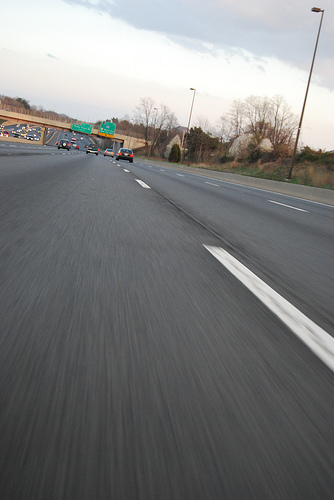
Photo by Chris a.k.a ~Crush~.