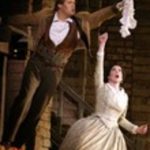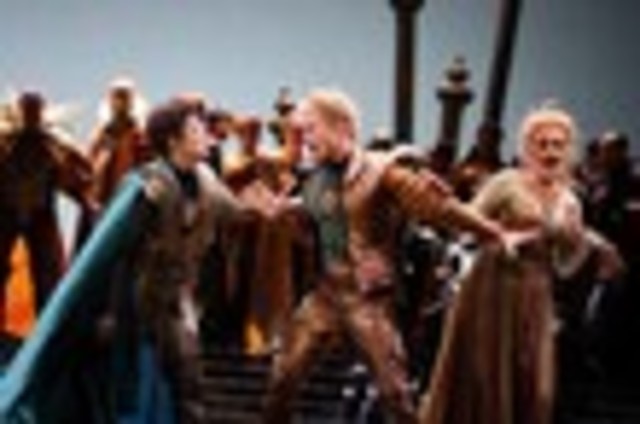

Kate Aldrich, Vittorio Grigolo, and Renée Fleming in Lucrezia Borgia, Washington National Opera, photo by Karin Cooper
On Saturday night, Washington National Opera opened a new production of Donizetti’s seldom performed Lucrezia Borgia, created for Renée Fleming’s first stage appearance at the Kennedy Center Opera House. The American soprano’s debut in this opera’s title role, at La Scala ten years ago, ran afoul of that theater’s infamous loggionisti. In a recent interview Fleming said that she regards the unruly crowd’s booing as a “badge of honor,” noting that part of her reason for returning to the role is to “get back on the horse again” and reclaim Lucrezia.
Fleming’s fame comes from operas of a rather different kind, those of Strauss, Dvořák, and Tchaikovsky, as well as Handel and Mozart, although to a lesser degree. Thus far, however, the bel canto repertoire has eluded her, largely because her vocal style is not suited to it. She often powers her way through delicate lines and high pianissimi with a heavier vibrato, and she tends to scoop up to notes. Her renditions of complex fioriture, the bread and butter of the bel canto soprano, have never been that agile or well delineated. This time Fleming showed a willingness to control some of those mannerisms, especially in her Act I aria “Com’è bello,” which had a calm simplicity quite appropriate to the bel canto style. Scooping, sour intonation, and raw low notes returned throughout the evening, however, especially when she seemed to let her guard down and react more instinctively.
Donizetti had to complete the opera very quickly, since Felice Romani sent the libretto (English translation) behind schedule. It adapted a recent and rather controversial play, Victor Hugo’s Lucrèce Borgia, premiered only a couple years earlier. Lucrezia Borgia, the illegitimate daughter of the man who became Pope Alexander VI, was a notorious member of an infamous family. Praised as one of the most beautiful women of her era, she was married to three different men, and monstrous sexual rumors circulated about her, most of them utterly baseless. Hugo’s play, and Donizetti’s opera to a degree, capitalize on her reputation as a venomous femme fatale, while contradicting that image with an invented story about her discovery of a long-lost child and her subsequent, accidental poisoning of him.