
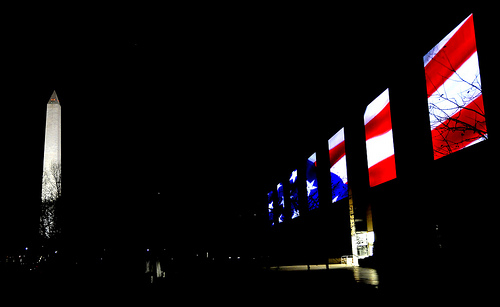
 The Washington Post’s Marc Fisher writes an expansive review of the newly improved Smithsonian National Museum of American History, which opened just yesterday. Fisher sums up the questions that a lot of people, this writer included, had about the state of the museum post renovation:
Will the history museum embrace a dumbed-down, rah-rah approach to telling the American story, or is there a way to blend corporate financial support with the rigorous and questioning content that visitors deserve?
To be fair, it’s virtually guaranteed in this day that museums, even public museums, must embrace corporate financial support. Private support doesn’t guarantee a gloss over content. Smithsonian hawks know that in many cases within the recent history of the Smithsonian Institution, it has been public support — and the strings that come attached — that have led to programming frustrations. Certainly private and corporate sources of financial support come with their own drawbacks, but the funding at our public institutions is sufficiently mixed, and the compromises accordingly complicated, that it would be difficult to look at the state of the new American History museum and say that is the fault or the success of corporate giving alone.
That said, there is a larger trend in museum direction to treat museums as entertainment centers rather than educational organizations, and nowhere is this spirit clearer than in Washington, where private centers of dubious educational value have in recent years proliferated. The once-respectable Newseum reopened as a print-themed Epcot Center, with a cavernous interior atrium design that disguises (exposes?) a lack of content relative to the building’s size. The Newseum’s fairly pornographic 9/11 shrine is shameful, to boot. The Museum of Crime and Punishment and the International Spy Museum are both low-rent theme-park institutions that feature ticket prices that rival that of the Museum of Modern Art in New York. Madame Tussaud’s wax museum doesn’t promise educational content, but it occupies the same block and nearly the same institutional status as the torture and spy museums.
Does American History deserve comparison with these institutions? That’s surely too bold a claim to make about a museum that houses the Star-Spangled Banner and has in the past featured strong programming that grapples with America’s real, and sometimes very terrible, history. Yet certainly aspects of the museum seem to cater to the broadest possible audience rather than present the best-possible program. As Fisher notes, “A Hall of Invention is a colorful and hands-on new introduction to the museum’s science wing, but it feels more like something out of a very good children’s museum than any exploration of the entrepreneurial spirit that has made this a nation of extraordinary innovation.”
That sounds like new flash rather than new substance. This writer hasn’t seen the newly restored museum yet but wasn’t happy with a lot about it before it closed. Any reader before-and-after reactions to the renovated National Museum of American History?
Photo by andertho.