On the eighth day, God invented the turkey, so that man would have something to deep-fry. I have only come to this conclusion after years of doing my patriotic duty to consume massive amounts of turkey on Thanksgiving. The basic approach when frying a turkey is, well, rather similar to frying anything else. The main difference is the amount of oil involved (5 gallons in my case), and the lack of batter. The resulting skin is crispy and delicious, and the short cooking time keeps the meat from drying out. Also, once the turkey comes out of the oil, you now have a ready-made setup in which you can fry anything else that you might have in mind: chocolates, pumpkin pie, or in my case, bacon. The only real downside of this method is that there are no pan-drippings for making turkey gravy, but that can be remedied by separately roasting some turkey bits if you so desire. Here’s how you proceed:
Step 1: Obtain Equipment/Turkey
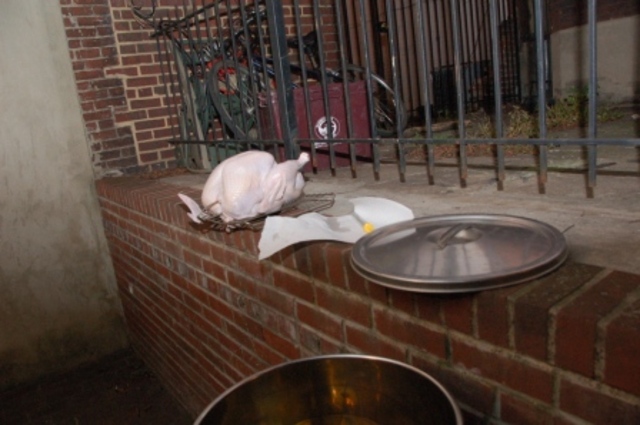
There are safety risks involved with frying a turkey, and as such, all frying activities should be done outside, as far away from your residence as possible. If hot oil overflows the kettle it has the potential to ignite and burn your whole place down. Since that’s generally a bad idea, you’ll need to get your hands on a large pot (8 gallons is a good starting point) and a propane burner to heat it with. You’ll also need a rack to use when transferring the turkey into and out of the oil, and ideally, a frying thermometer to make sure your oil is at the right temperature. As for the bird itself, you can fry any turkey as long as it doesn’t weigh more than 15 pounds. If you’ve got a crowd that requires more turkey than that, you can always roast another turkey at the same time.