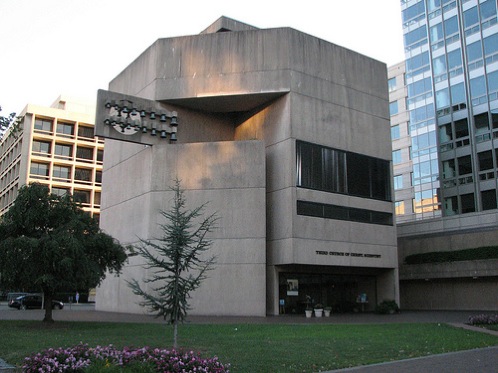
 Marc Fisher writes up his notes on a government hearing to decide the fate of the downtown Brutalist building used by Third Church of Christ, Scientist. But he might as well have stayed home. Though he notes that the purpose of the hearing was to determine specifically whether staying in the building at 16th and I Streets NW presents a financial hardship for the church’s membership, the complaint and arguments that Fisher addresses in his summary are old hat to anyone who’s been following the issue.
For those who haven’t been keeping up, the question at hand — well, that depends on whom you ask. Fisher notes:
The question before [D.C. planning director Harriet] Tregoning is whether to approve the church’s request to raze the building. But just as the city’s Historic Preservation Board refused to consider any First Amendment issue in the case–does a city government, trying to preserve its architectural heritage, have the right to tell a religious organization what to do with its sanctuary?–so too is Tregoning limiting testimony mainly to whether the Third Church would face an undue financial hardship if it were forced to keep a building it says it cannot afford.
On that First Amendment issue: Architectural preservationists say it’s irrelevant. The practice of the church does not flow from the property (it’s not built on ancient Christian Scientist burial grounds for example). But the sanctuary on that property is quite important to District and architectural history. Where does the First Amendment become an issue?
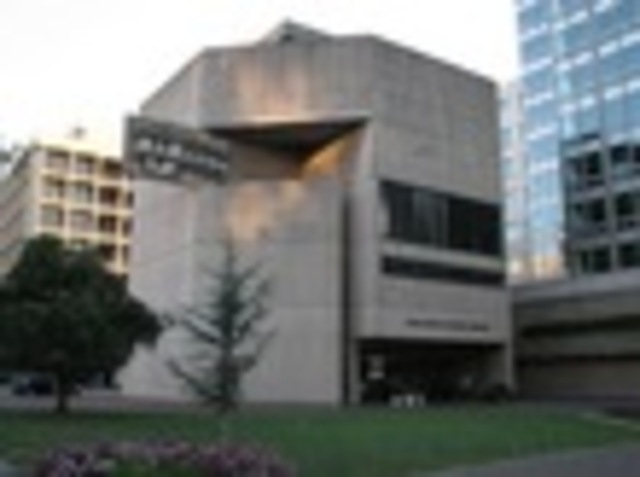
One party that gets lost in the conversation about the costs imposed by the concrete-poured building (designed by Araldo Cassutta of I.M. Pei & Partners)? The Third Church of Christ, Scientist. It often seems, the way Fisher reports the issue, that some awful group of Modernists came along and foisted this building upon a humble band of religious practitioners. But no: In fact, the Third Church of Christ, Scientist, commissioned and built this building, ostensibly seeking to benefit from its novel architecture. And until fall of this year, the church itself praised the award-winning architecture on its Web site and in church literature.
Photo used with permission under a Creative Commons license with Flickr user ElvertBarnes.