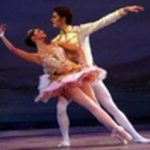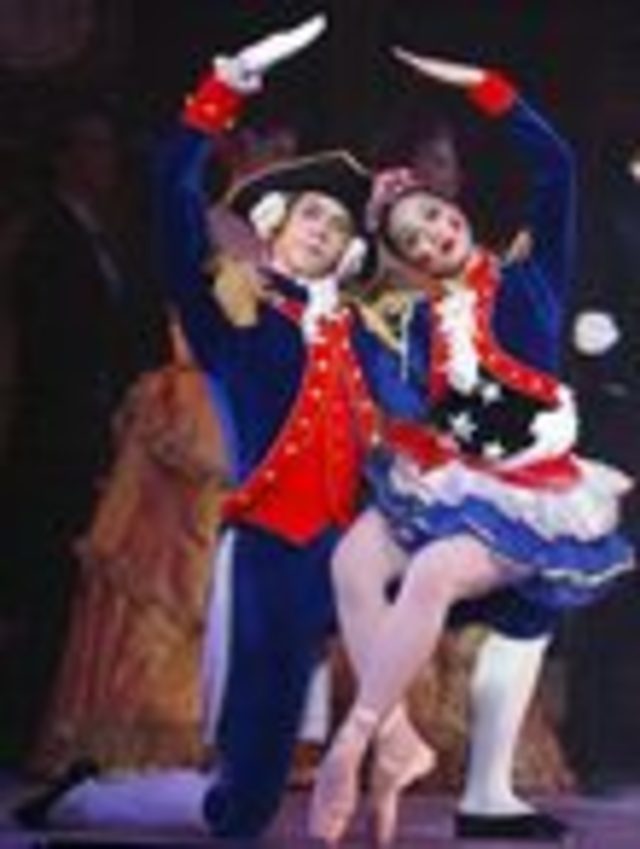
 John Paul Jones and Miss Liberty, Act I, The Nutcracker, Washington Ballet (photo by Carol Pratt) John Paul Jones and Miss Liberty, Act I, The Nutcracker, Washington Ballet (photo by Carol Pratt) |
Washingtonians certainly have enough options to take in a performance of Tchaikovsky’s evergreen Christmas ballet The Nutcracker this month. Given the choice this weekend, the more traditional extravaganza version offered by the Joffrey Ballet at the Kennedy Center lost out to the Washington Ballet‘s revival of Septime Webre’s re-imagining of The Nutcracker at the Warner Theater.
Septime Webre, artistic director of the Washington Ballet, gave the company a huge hit by re-envisioning this most often performed of ballets, based on a short story by E. T. A. Hoffmann (Nussknacker und Mausekönig) as revised by Alexandre Dumas père as L’histoire d’un casse-noisette, in Washington, D.C. Many other choreographers have updated the story, but Webre’s staging takes the cake, because of the extravagantly colorful and dynamic sets (designed by Peter Horne) and Washington-specific costumes (Judanna Lynn) and other details. As set in Washington in 1882, Clara’s family lives in a well-appointed mansion in Georgetown, and their Christmas Eve party is attended by Frederick Douglass, among other guests. Drosselmeyer’s spring-activated toys become the pair of John Paul Jones and Miss Liberty (instead of Harlequin and Colombine), followed by a rather menacing Hopi kachina doll (instead of the soldier).
When Clara falls asleep by the Christmas tree, she sees rats, of course, instead of mice, and the Rat King looks like King George III (and Betsy Ross and Benjamin Franklin make a cameo appearance). The king and his redcoats battle the Nutcracker, who looks like George Washington, and toy soldiers as the American revolutionary army. Instead of the Land of Sweets in Act II, Clara and her prince are transported to the Land of Springtime, with cherry blossoms at peak by the Tidal Basin, coloring the sky pink. The Springtime Sugar Plum Fairy is attended by butterflies, mushrooms, bees, and charming animals with funny head masks. She entertains Clara and her prince with Spanish and Chinese dancers, as well as a sultry pair of Anacostan Indians (for the Arab dance), an acrobatic frontiersman (the legendary Davy Crockett, for the Russian dance), bright red cardinals and a tom cat (for the Mirlitons), Mother Barnum and circus clowns (for Mère Gigogne and the polichinelles), and cherry blossoms for the flowers. The only detail he missed was to have worried Washingtonians buying up milk, bread, and toilet paper in the snow scene.