DCist’s highly subjective and hardly comprehensive guide to the most interesting movies playing around town in the coming week.
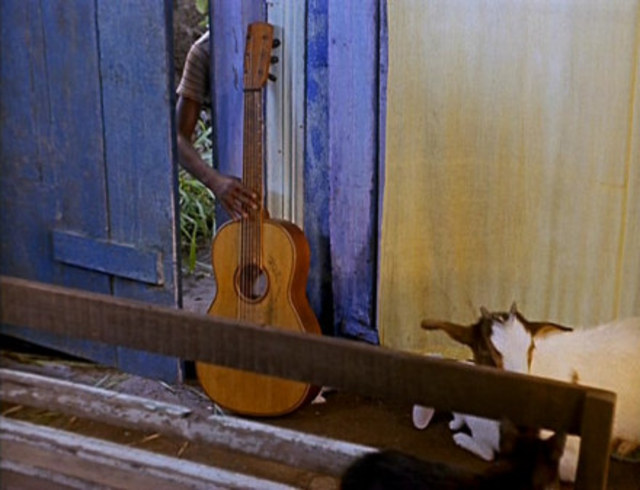
As Slumdog Millionaire bears down on Oscar night the odds-on favorite to capture plenty of little golden statue glory — hopefully at the expense of potential big-time loser Benjamin Button — it seems a good time for a screening of another film about the oft-ignored under-classes of a major city. In the case of Marcel Camus’s Black Orpheus, the city is Rio de Janeiro, and the time is carnival. While not as gritty as City of God (or even Orfeo, the 1999 remake), this 1959 film gave world audiences a look at life in the poorer quarters of Rio they’d never seen before, as well as introducing Antonio Carlos Jobim, and bossa nova music in general, to many outside of Brazil for the first time.
Camus’s film is a modern recasting of the Greek myth of Orpheus and Eurydice — it’s a popular story for film, literature, and musical adaptations and references, perhaps because of Orpheus’ position as both a venerated poet & musician and a brave mythical hero. And his tragic end after coming this close to accomplishing the impossible in his attempt to rescue his deceased love from Hades-fire makes for an excellent story. In Black Orpheus, Camus makes Orpheus a poor trolley driver (and aspiring musician) bound to a fiancée he doesn’t really love. His Eurydice is a mistress, who is being pursued by a death-masked reveler in the impending Carnival, as well as by his jealous fiancé once she catches wind of their affair. If you know the myth (or Greek tragedy in general), you can see where this is headed; but despite its inevitably dark ending, Camus uses the bright colors of Rio and the bouncy rhythms of the bossa nova to create a vibrant and inspiring landmark of a film.
View the trailer.
Wednesday at 11 a.m. and 7 p.m. at the Anacostia Community Museum. Free.
—
You probably figure you’ve seen this movie before, right? Inexperienced teacher gets stuck in a class of rambunctious minorities from the rough part of town, and everyone rises above their differences and is inspired by the unsullied beauty of knowledge instilled with passion and talent. This plot has been done so many times it practically writes itself. The fact that French director Laurent Cantet has made a movie within this framework yet turned the entire formula on its head is probably a big part of the reason for the film’s huge success, which includes the top prize at Cannes last year and a nomination for best foreign film at the Oscars. Cantet’s film is based on François Bégaudeau’s semi-autobiographical novel of his own experiences as a teacher; Bégaudeau stars here, essentially in a fictionalized version of his own life. That, combined with Cantet’s rigorous and lengthy preparation with the student actors and his constant use of multiple cameras within the classroom (where most of the film takes place) gives the film a sense of documentary realism that trumps the inspiration-by-numbers of the average student/teacher drama.
View the trailer.
Opens tomorrow at Bethesda Row and E Street.