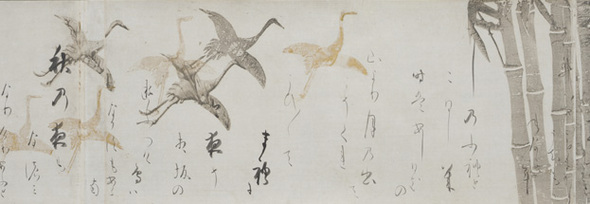
 Tawaraya Sotatsu, Imperial Anthology, Kokinshu, early 17th century, handscroll; ink, gold, silver, and mica on paper, image courtesy of Freer Gallery of Art
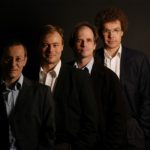
The best concerts on the Bill and Mary Meyer Concert Series of free concerts at the Freer Gallery of Art explore the intersection of European and non-Western music. Last night’s program, performed by the Leipzig String Quartet, did just that by combining music by three of Asia’s most important composers, all experimenting with the sounds of the European 20th century avant-garde, with that of an American composer, John Cage, fascinated by Zen philosophy.
The group brought an etched clarity and multicolored approach to the two Japanese works that opened the first half, the third string quartet by Toshio Hosokawa (Silent Flowers, 1998) and Tōru Takemitsu’s In a Landscape, from 1961. The former composer has succeeded the latter as Japan’s leading voice in contemporary music, and both compositions refract modern atonal techniques through the lens of Japanese arts, Ikebana (floral art), noh theater, poetic calligraphy, and gagaku (the music of Japan’s imperial court). In both works the composers build up clusters of sound through glissandi, harmonics, pitchless scrapes, and other unusual string techniques, exploding from pizzicati or other percussive sounds, which then recede slowly to silence. Listening to them was mostly a thankless task, quite frankly, until a totally unexpected sonority blossomed out of the nothingness, like the strands of harmonic-filled clusters that evaporate into the high altitude at the end of the Hosokawa work.