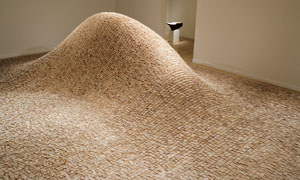
 2×4 Landscape, 2006, Wood, (installed dimensions variable). Courtesy of PaceWildenstein.
Maya Lin readily admits that her career is made up of three different areas: architecture, memorial and art. The memorial line, which she calls it, started here in Washington, D.C. over 20 years ago, when she won a competition to design the Vietnam Veterans Memorial.
Since then, Lin has devoted the different aspects of her “tripod” career to the development of her voice in connection with landscapes. In Systematic Landscapes, the Corcoran Gallery of Art showcases Lin’s exploration of the collision of technology and nature.
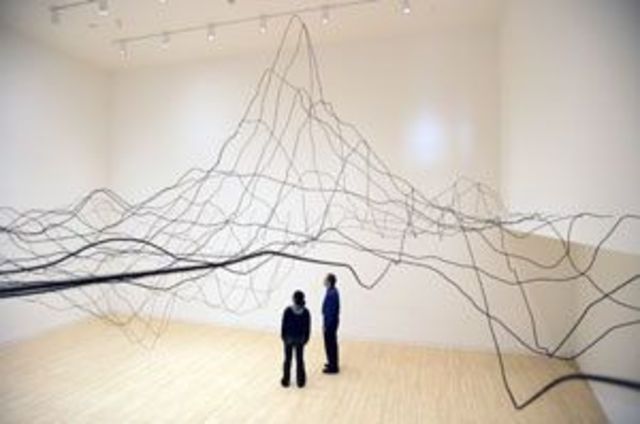
In this exhibit, pieces of landscape and geographical phenomena are transformed and reinterpreted through a technological lens. Hills, rivers and bodies of water are taken from the out of doors and brought inside the gallery setting. These sculptures are often large and dramatic.
The installation, 2×4 Landscape, consists of over 50,000 2×4 inch sections and almost fills an entire room. The small pieces hug the floor of the gallery then gently thrust up creating a hillside ten feet tall. From a distance the hill’s lines are smooth and fluid, but the small pieces become pixilated and the hill jagged upon closer examination. Its presence in the gallery forces you to think of how you experience a hill outside versus the interpretation of one inside.
During the installation, 2×4 Landscape had to be modified to fit the space. Natural settings and landscapes are also routinely modified to accommodate encroaching human settlements. These layers of conservation and environmentalism are present throughout the exhibit with subtle touches. For example, 2×4 Landscape was created with sustainable and responsibly harvested wood. As a self-proclaimed environmentalist, Lin doesn’t like to preach. She said that the work in the exhibit begs for us to look further and more in depth at the world around us.
The Caspian, Dead and Red Seas are some of the most endangered bodies of water in the world. In a series called Bodies of Water, Lin depicts these endangered landscapes with carefully layered and carved pieces of plywood. The plywood is layered just so in that it looks like topography but instead of indicating height, the layers show depth. The sculptures highlight the geography of these seas, like a negative or an ice cube taken out of its mold. They illustrate the great weight of the water and the intricate details of the geology. They are balanced on their lowest and deepest point and placed slightly lower than eye level. This forces you to view the volume of water in its entirety, instead of just the outline of the surface most often seen outside or on a map.