
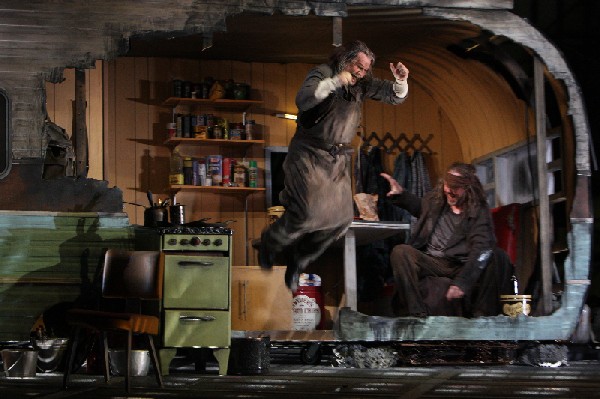
 Andreas Conrad (Mime) and Alan Held (Wanderer, seated) in “Siegfried” at the Washington National Opera, directed by Francesca Zambello (photo by Karin Cooper)
Washington National Opera continued its epic American Ring Cycle on Saturday night, opening a production of Wagner’s Siegfried that was plagued by vocal and technical troubles but was still an evening of revelations.
Director Francesca Zambello continued the work begun in her 2006 Das Rheingold and 2007 Die Walküre, which transferred Wagner’s epic cycle of four operas from its German mythology to the founding legends of the United States. Essentially, the conflicting forces were cast in terms of the wealthy and poor in American life, with the gods shown as the loafing rich, walking up a rainbow bridge that looked like a cruise ship’s gang plank while sipping champagne. Wotan plotted his plans for control of the world from a Valhalla that looked like an executive board room at the top of a Manhattan skyscraper, while Alberich’s enslaved Nibelungs were cowering African-American slaves and the giants, who built that skyscraper for the gods, were rough-necked Teamsters. Siegmund managed to rescue Sieglinde from a life of spousal abuse on the American prairie, and now their son, Siegfried, is raised by an impoverished tinkerer, Mime, squatting in a beat-up trailer in a filthy junkyard (set design by Michael Yeargan). No Siegfried has probably come from so far on the wrong side of the tracks to win the daughter of the richest man in town.
The same criticism of the first two operas continues to hold true, in that taken as a whole the individual scenes, set in wildly different times and locales, do not add up to something coherent. The production is left-leaning in a fairly heavy-handed way (the Washington Times critic labels it “socialist“), but somehow casting the struggle of the gods against the races of the earth on the battleground of American capitalism makes sense dramatically. In Siegfried, Zambello leans even closer to the infamous environmental message of the Patrice Chéreau Centennial Ring at Bayreuth: the opening projected images of clouds slowly become instead the choking fumes of smokestacks, the poisonous blood and spittle of the dragon become the polluting by-products of the industrial revolution. The dragon is conceived as an enormous mechanized digger, with the Teamster Fafner inside the cabin.