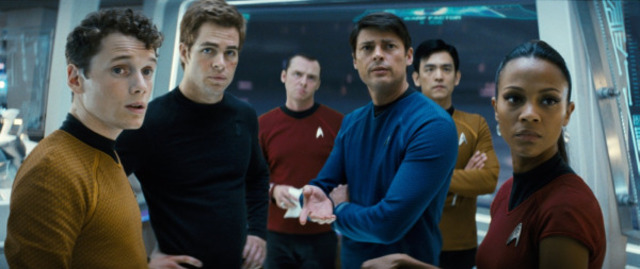
 J.J. Abrams takes the fresh faced new crew of the Enterprise where no Star Trek movie has gone before.
***There’s a plot point discussed in the first parapraph that a couple of people have called foul on; my feeling is that if it’s exposition and happens in the first five minutes of the movie, then talking about it hardly qualifies as a spoiler, but if you want to go in as an utterly blank slate, you may want to skip it. So, that said, let this serve as fair warning for a potential spoiler.***
If imitation is the sincerest form of flattery, then J.J. Abrams’ reboot (and reinvigoration) of the Star Trek series can be looked at as both a big sloppy wet kiss to the late Gene Roddenberry, or a sneering middle finger flashed in the direction of the sci-fi impresario. On the one hand, Abrams lovingly recreates the universe conceived by Roddenberry, with so many nods to tradition, and Trekkie-centric in-jokes that you’ll need a scorecard to keep up. On the other, Abrams starts the movie with a history-altering time-travel event that essentially allows him to rewrite the entire Star Trek mythology from scratch. Yes, this is a prequel, and the events of the television series and the ad nauseum pileup of subsequent films haven’t happened yet. But Abrams goes a step farther and says that most of these things are never going to happen. In the film’s first sequence, the newborn James T. Kirk’s father is killed in the act of saving baby Kirk and his mother from time traveling Romulans from the future, and this act has a ripple effect that changes the fortunes of every character in the series.
It’s a neat trick, and it’s going to piss off the convention-going, pointy prosthetic-eared crowd to no end. But in terms of finding fresh life in a universe that long ago went stale, it’s a stroke of genius. Let’s face it, Star Trek movies stopped pretending they were for anyone but die hard fans a good while back, a fact to which their modest budgets and increasingly modest box office success attested. Once they completely jumped the humpback whale shark in Star Trek IV: The Voyage Home, general audiences could be excused for caring less and less. And as good as Wrath of Khan is, it still feels like medium-budget soundstage science fiction. Its worlds rarely feel bigger than a studio backlot. The underrated Star Trek: The Motion Picture, unfairly maligned for having the temerity to try out a more thoughtful, less action-oriented tone than the TV series, is really the only entry in the entire series that had a broad sense of scope, that paints to the edges of the canvas. Until now.