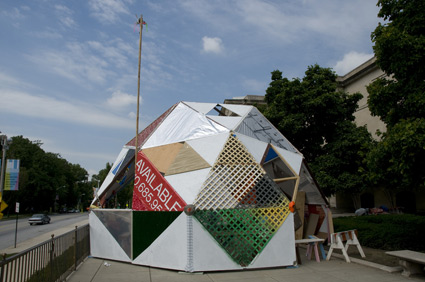
 The Baltimore Development Cooperative took home the $25,000 Sondheim Artscape Prize on Saturday.
On Saturday, the Baltimore Office of Promotion & The Arts, acting in conjunction with Baltimore’s Artscape festival, hosted an opening at the Baltimore Museum of Art to announce the Sondheim Artscape Prize — the Mid-Atlantic region’s most prestigious art awards. Baltimore Mayor Sheila Dixon was on hand to announce the winner of the prize: the three-artist-team known as the Baltimore Development Cooperative.
Think there’s any way an artist without a Charm City zip code wins that prize?
For the fourth year in a row, the D.C. artists who made it through the semifinalist round to the finalists’ circle lost the Sondheim to a Baltimore peer — and the $25,000 that comes with the prize. The Baltimore Museum of Art gives viewers a great opportunity to judge the work for themselves, offering three vast galleries over to works and installations by the artists up for the award.
It’s the same exhibit that jurors see when they choose the winner. This year, those jurors were New York artist Ellen Harvey, Contemporary Arts Museum Houston curator Valerie Cassel Oliver, and Whitney Museum of American Art photography curator Eve Sussman.
For viewers and visitors from D.C., the award ceremony feels like a game being played on the road. Mayor Dixon presents the prize each year. In her introductory remarks, Baltimore Museum of Art director Doreen Bolger explained that between the Sondheim show and the H&H arts building afterparty, there was “probably more art on view in Baltimore than there has ever been before.”
That’s great for Baltimore. But there are artists who nearly take the prize whose names don’t include the word “Baltimore.” This year, two of those artists hail from or are represented in D.C.: Ryan Hackett and Molly Springfield. (Springfield was also a finalist last year and a semifinalist the year before.)
“I’m disappointed that our D.C.–based artists didn’t win, because they represented it very well,” said D.C. art doyen Philippa Hughes. She said that in particular she was a fan of Springfield’s work.
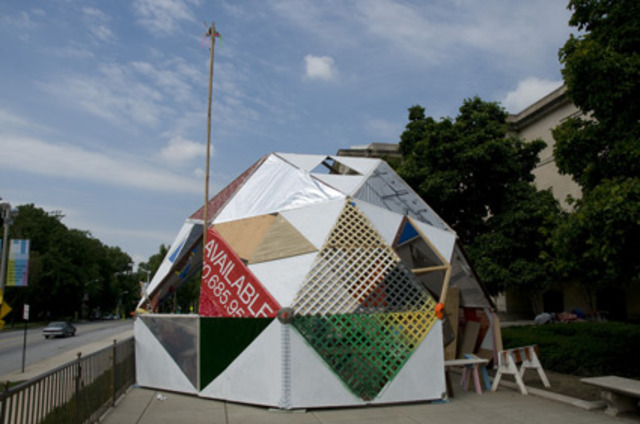
With fully a third of the artists in the finalists’ circle claiming the District, Baltimore shouldn’t get too comfortable with the notion that the prize confirms Baltimore cultural values. It sure did this year, though. The Baltimore Development Cooperative were in many ways the underdogs. They were the only group in the contest; they are not represented in a commercial gallery — hell, they hardly make art objects at all. For the most part, their work is the activism they coordinate from the 16 vacant lots in east Baltimore they’re squatting on.
Art viewers from the District and elsewhere in attendance were wondering how the Baltimore Development Cooperative, whose geodesic tent is pictured, beat out the more elegant objects by Hackett and Springfield. Only the jurors can answer that. Still, for four years in a row, outside jurors have repeatedly picked Baltimore artists over everyone else to take this prize. Is D.C.’s year coming up?
FULL DISCLOSURE: Molly Springfield is a friend of both the author and the editor of this web site.