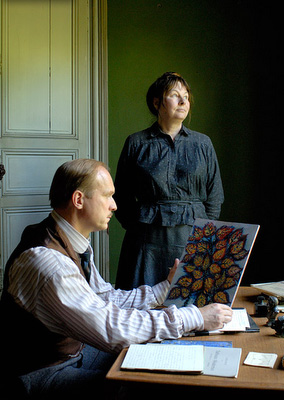
 Ulrich Tukur (Wilhelm Uhde) and Yolande Moreau (Séraphine Louis) in Séraphine
Séraphine Louis (1864-1942, dite Séraphine de Senlis), the subject of the recent film Séraphine, is not exactly an unknown painter. Her work is found in only a few museums now, including the Museum of Modern Art in New York (Les Pommes and Tree of Paradise). She was a naive painter, an ultimately unsatisfactory but unavoidable term indicating that although she was untrained, she painted as a sort of compulsion, what now is sometimes called visionary art. Director and screenwriter Martin Provost drew most of the material for his film from the work of Françoise Cloarec, who has also just published a version of her thesis on the painter with Editions Phébus. Provost has come out of practically nowhere as a director, his last film Le ventre de Juliette having won a prize at the 2003 Avignon Festival, to come close to a clean sweep of this year’s César Awards, the French Oscars, with this beautifully crafted movie.
The paintings of Séraphine de Senlis were first championed by the collector Wilhelm Uhde, played with patrician reserve by Ulrich Tukur. When he comes from Paris to Senlis under somewhat murky circumstances in 1914, Uhde is surprised to find his next discovery scrubbing the floors of his rented rooms. We learn a lot about Séraphine’s existence, in a moving, witty performance by Yolande Moreau, before we know anything about her painting, which reveals the art as just another part of her unusual life. She scrimps together a living serving as a maid, scrubbing linen in the river, occasionally cooking for nuns in Clermont, where she spent part of her early life after being orphaned. All the while she is collecting odd things — cow’s blood, used candle wax, ochre-colored mud, wildflowers — that we later learn serve as special pigments, creating the inimitable colors of her paintings. Unfortunately, Uhde has to flee France suddenly as the battles of World War I approach Senlis, fearing he will be shot as a deserter. When Uhde has returned to France a decade later, he reconnects with Séraphine and helps sell her art, providing income that allows her to focus on painting and, unfortunately, helps lead to the breakdown that ultimately leaves her confined to an asylum for the last decade of her life.