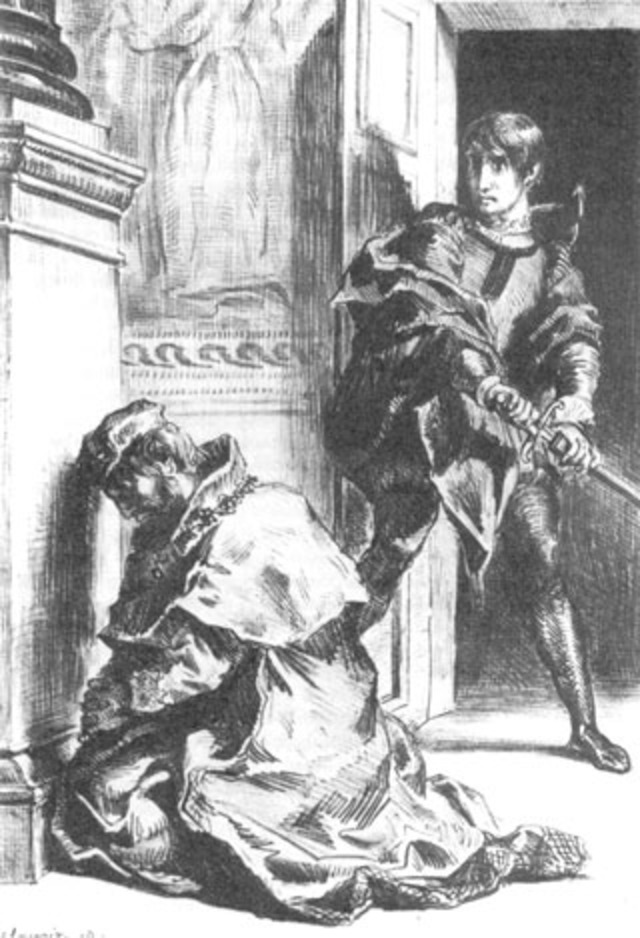
 Poor Prince Hamlet can’t bring himself to slay his treacherous, usurping Uncle Claudius while the guy’s at prayer.
To be, or not to be. That is the . . . point?
Mayhaps. Every script goes through revisions. The script of a play — Hamlet, say — that predates copyright law, and that was often scribbled down as it was performed and passed around in incomplete or inaccurate transcripts, could diverge in innumerable directions, like a game of telephone (albeit 280 years before the telephone). ‘Twasn’t until 1623, seven years after William Shakespeare’s death, that two of his former colleagues in the King’s Men compiled reliable versions of 36 of his plays in what’s now referred to as the First Folio.
In his absorbing experiment Bad Hamlet, playwright/producer John Geoffrion pares Shakespeare’s longest play to its most iconic scenes, but stages it in a kind of binary format, with the First Folio version and an earlier version attributed to 1603 performed simultaneously.
Snatches of verse that vary from the ones still familiar to us four centuries on are fun to spot for Shakespeare geeks. But what’s more diverting is to watch two actors tackle the same roles (and substantially the same speeches) simultaneously, engaging in a sort of verbal ballet that occasionally lands on a symmetrical line reading. A dextrous company of six gives us dueling, sometimes gender-blind characterizations of Polonius, Ofelia, Laertes, and of course, the titular melancholy Dane, portrayed by John Robert Keena in the 1603 “Quarto” version, and Matt Volner in the more familiar Folio text.