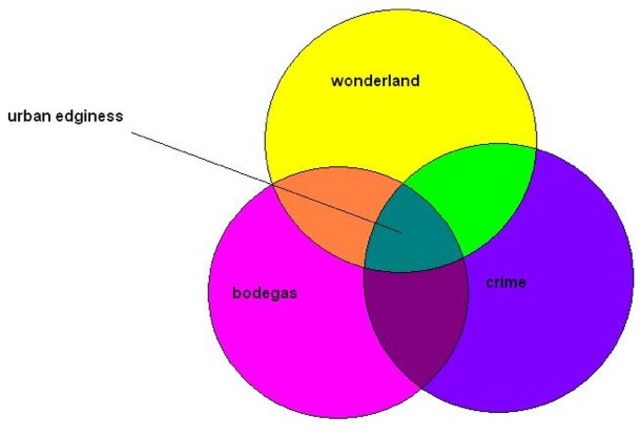
 Our attempt to diagram out the logic behind choosing to live in Columbia Heights, according to the Washington Post’s Monica Hesse. (Illustration by Amanda Mattos)
Some time ago I asked the DCist writing staff to avoid using the term “hipster” whenever possible. It’s a word we all hear and say plenty, but I’m never quite sure what different people really mean by it. Is it just someone who wears skinny jeans and Chuck Taylors? Is it people who compost and keep chickens in their urban gardens? Is any man under 35 who has unusual facial hair a hipster? What’s the difference between a scenester and hipster? Are you talking about these people? Or these people? Until I figure out some satisfactory answers, I prefer our writers be more specific about what they really mean. Using “hipster” just seems lazy and vague.
So you can imagine how hard Washington Post Style reporter Monica Hesse’s story today, titled, “The Target Of Their Ambivalence: Suburban-Retail Icon Seduces Hipsters Of Columbia Heights”, rubs me the wrong way. The lede alone is enough to make me want to pull my hair out:
For the hipsters, post-hipsters or quasi-hipsters who moved into Columbia Heights several years ago for the grit and the cheap rent and the proximity to the Wonderland Ballroom (the hipster, post-hipster or quasi-hipster bar that sponsors local music and nights like “Sundress Fest”), life can be divided into two discrete phases: Before Target. After Target.
Nevermind what “hipster” means, what the hell is a “post-hipster” or a “quasi-hipster”? Hesse offers nary a single definition in her 1,300 word examination of how the young (and presumably mostly white) people who live in Columbia Heights feel about the changes in the neighborhood and the arrival of Target and the rest of the DCUSA retail complex and its affect on their spending habits.
It’s not that this isn’t potentially a valid subject for a Style story. The effects of having big box chain stores suddenly plop down in the center of the city is worth writing about. But Hesse’s diagnosis of the situation starts out wrong and never manages to right itself. Consider this passage, where “complex” refers to the DCUSA retail development:
But this complex is not why the quasi-hipsters of Columbia Heights had moved to the neighborhood. They were seeking bragging rights, and bodegas spilling over from Mount Pleasant. They were seeking urban.
Columbia Heights is still edgy. A few blocks from the Target, semi-permanent police cars monitor the muggings and shootings that still happen, in broad daylight, even — as happened a few weeks ago — at the Metro. This is an area being either positively revitalized or negatively gentrified, depending on how you view the development. It was a thriving, predominantly black neighborhood before it was ravaged by the 1968 riots, and now everyone is trying to either restore it to its former glory (save the Tivoli!) or make it into something new.
Ugh. Now, as far as I understand it, Monica Hesse lives (or at least at one time did live) in Columbia Heights, so maybe she’s writing about herself here, but the idea that anyone ever moved to the neighborhood did so in order to “brag” about how much crime happens near their homes is just insane. Without even dealing with the fact that the vast majority of Columbia Heights residents are still non-white families who might well be happy about the convenience and low prices that Target and Marshall’s and the like now afford, a number of actual reasons for choosing the neighborhood immediately spring to mind: convenient location and public transportation, affordability, charming rowhouses, or even, say, liking the vibe of the community. It seems safe to say however that no one, ever, in the history of gentrification, has moved to a neighborhood for the apparently more authentic experience of shopping at a CVS.