DCist’s highly subjective and hardly comprehensive guide to the most interesting movies playing around town in the coming week.
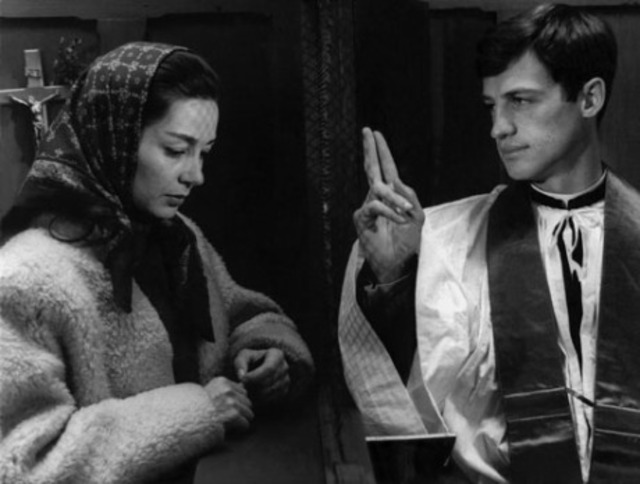
This underrated masterpiece by Jean-Pierre Melville received a belated theatrical release in the U.S. earlier this spring. Belated by nearly a half-century, as it was originally released in 1961, and for some reason had never been distributed in the U.S. It still hasn’t been released here on DVD, an oversight that will hopefully soon be remedied now that the film has made some all-too-brief rounds. The titular priest here is played by Jean-Paul Belmondo, probably the French actor of that era who looked least like a priest. Watching him here in his frock is a little jarring, as we’re more used to him as a thug or a hustler, and his youth and raggedly dangerous good looks seem out of place here. It works to marvelous advantage in a story about a priest with a strange attachment to counseling young women – women who inevitably fall for him. Morin, however, never succumbs; it’s as if he’s constantly leading himself to temptation, and then delivering himself from evil.
Despite the title, this isn’t really Leon’s story, as it is more concerned with Barny (Emmanuelle Riva), a widowed mother and a Communist relocated by the war to this small village in occupied France during WWII. She’s a long-lapsed Catholic, and only enters Morin’s confessional booth to tell him and his religion off; when he responds calmly and intellectually, it begins an interaction that challenges both his beliefs and her non-beliefs. It’s a work of beautiful subtlety from Melville, with a strong undercurrent of sexual, political, and philosophical tension.
Also worth mentioning, while we’re talking about French films at the National Gallery, is the museum’s Alain Resnais retrospective, which kicks off this weekend, runs for the next two weeks, and covers all phases of his long career. Bad news, though, for those who were looking forward to Hiroshima mon amour this weekend; that’s been cancelled and replaced by Je t’aime, je t’aime, but the subsequent screening of the incomparable Last Year at Marienbad is still on schedule.
View the trailer.
Léon Morin screens Sunday at 4:30 p.m. at the National Gallery of Art. Also at the National Gallery, the museum’s Alain Resnais retrospective begins Saturday afternoon and runs until September 20. Free.
—
Cinema & the Spanish Civil War
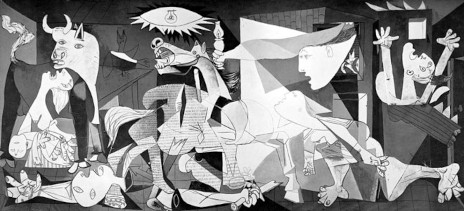
Repressive political regimes have always been effective catalysts for great works of art. The Spanish Civil War in particular, and the brutal fascist regime of Francisco Franco that it installed for nearly 40 years, served to inspire some of the greatest art and literature of the 20th century. The AFI, in conjunction with the Embassy of Spain and the British Film Institute, has assembled an impressively diverse array of the films specifically about that war, its aftermath, or using them as a backdrop. Highlights include Ken Loach’s typically fiery Land and Freedom, Alain Resnais’ atypically straightforward (and thrilling) The War is Over, and perhaps the best of the bunch, Victor Erice’s moving visual poem The Spirit of the Beehive. One might quibble that some excellent recent films have been left out of the mix here: neither of Guillermo del Toro’s Spanish Civil War fantasies made the cut, nor the award winning 1998 Fernando Trueba comedy The Girl of Your Dreams. But with such a great lineup, it’s hard to complain. Worth noting is that there is but one Hollywood product anywhere on the list, the 1943 Gary Cooper/Ingrid Bergman adaptation of For Whom the Bell Tolls. One wonders if studio reluctance to tackle a subject that captivated the rest of the international cultural community might have had anything to do with the United States’ rather embarrassing alliance of convenience with a fascist dictatorship during the Cold War.
Opens Friday at the AFI and runs until September 22. See the AFI’s site for a full schedule.