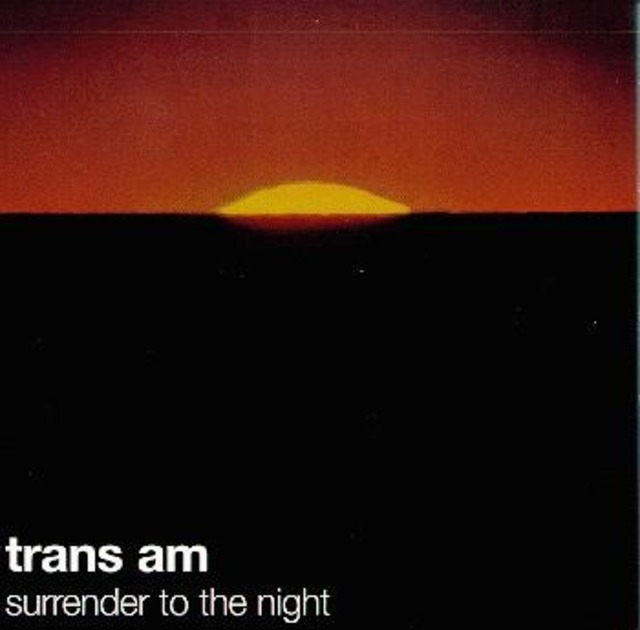
 Our occasional series “Secret History” features profiles of classic D.C. albums as a way of looking back at the District’s contributions to music over time. This installment looks back at Trans Am’s post-rock triumph, Surrender To The Night (Thrill Jockey, 1997).
The mid to late 1990s saw the emergence of post-rock, a Chicago-centric genre which filters Brian Eno-influenced experimentalism, progressive jazz, and electronic bleepscapes through a more or less standard rock lens, shedding what some believe are the constrictive rules of rock ‘n’ roll to forge a brave new sonic path. While occasionally sacrificing hooks and catchy melodies at the altar of navel-gazing abstraction, when done right, post-rock can push boundaries in exciting new directions.
Along with Tortoise’s Millions Now Living Will Never Die and The Sea And Cake’s The Fawn, Trans Am’s second LP, 1997’s Surrender To The Night, is one of post-rock’s crowning glories and a testament to the potential of the form. Over eleven tracks, the trio — Nathan Means (bass, keyboards), Philip Manley (guitar, keyboards), and Sebastian Thomson (drums) — fuse arena rock, Jan Hammer-esque ’80s TV chase themes, shoegaze, krautrock, dub, and who knows what else into a mind-blowing mélange of instrumental magic. It’s an album bursting with eureka moments, startlingly smart and awesomely rocking.
Despite having roots in the D.C. area – “We’re all from the near-in Maryland suburbs. We listened to lots of Dischord bands and played at and went to Positive Force benefit shows in high school,” Means tells DCist – the District’s Clinton-era indie rock community never seemed to fully embrace the band, whose sound didn’t fit the city’s standard post-punk profile. Says the bassist, “We were never really considered part of the D.C. scene. We headlined in New York City before D.C. On tour, everyone thought we were from Chicago. And even after years of living in Adams Morgan and Mount Pleasant and running a studio in Chinatown and becoming friends with people from all sorts of established D.C. bands, we are still never included in histories of the 1990s in D.C.”
There were some perks, however. “At least we got drink deals at the Black Cat,” says Means, “and our parties were always better than most slumming group house affairs.”