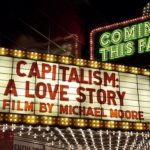
 When Michael Moore went looking for funding for his newest film, he claims he told the studio that it would be a kind of sequel to Fahrenheit 9/11, the director’s most financially successful film to date. They handed over the cash, and he turned around and made a film that has little to do with that anti-Bush polemic, that is instead unapologetic about biting the corporate hands that feed him. That doesn’t mean that Capitalism: A Love Story isn’t a sequel, though. It’s just that its direct antecedent is Moore’s debut (and arguably still his best), Roger & Me, which was released 20 years ago this December.
Roger & Me was an extremely personal film about the utter collapse of one American city, Moore’s hometown of Flint, Michigan, as a direct result of General Motors’ decision to move tens of thousands of jobs to Mexico and shut down the factories that formed the backbone of Flint’s local economy. Capitalism, at its core, takes on the same issues: corporate culture, the expanding gap between rich and poor, government complicity in the entire affair, but expands its focus nationwide. What keeps it from becoming unwieldy is that despite the bigger subject, the film feels nearly as personal as Roger & Me.
Capitalism is ostensibly Moore’s target, but he’s no economics professor, and his real targets are shady practices in the banking, investment, and mortgage industries, how bad an idea it is to hire executives from those industries to run the economy at the governmental level, the greed that wealth breeds, and ultimately, the catastrophic effects all of this has on the average American as the middle class steadily shrinks. The inexactness of his language will provide great fodder for his political adversaries &mdash quotes like “Capitalism is the opposite of democracy” makes for great sound bites, and Moore explains what he means by it, but it’s still fuzzy reasoning since he’s basically re-purposing the vocabulary to make his point.