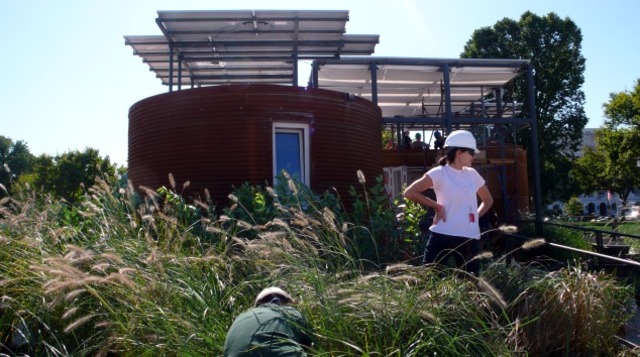
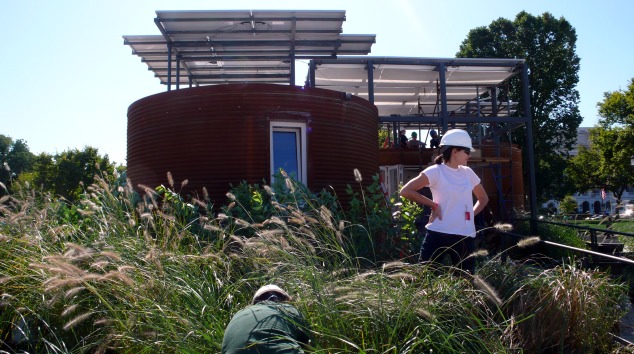
 A Cornell University team member surveys the landscaping in front of Silo House. Photo Credit: Angel Borrego Cubero/U.S. Department of Energy Solar Decathlon
By DCist Contributor Lauren Evans
Almost overnight, the National Mall has been transformed from an expanse of sickly grass to a prim neighborhood. The houses therein have everything yours does – hot water, appliances, lights and climate control – with one major exception: an electricity bill.
The Solar Decathlon, a biennial competition sponsored by the Department of Energy, features designs by students from 20 universities in both the U.S and abroad, who come to D.C in hopes that theirs will prove the most functional solar powered house of them all.
As per its name, the Solar Decathlon’s judges will rank the houses in ten different categories, everything from architecture and engineering to market viability. Despite a long list of qualifications and restrictions, each of the houses looks remarkably distinct from its neighbors.
Team Germany, the reigning champions of the competition, erected what looks like a shiny black box, with the house’s whole façade covered in solar cells.
Others have gone for a more agrarian look: Cornell University created what appears to be a trio of aging silos enveloped by a lawn-like field of grains. But in terms of function, the “Silo House” is far from the similarly shaped structures that dot upstate New York: the building’s exterior is weather proofed with soy-based, closed-cell spray foam that gives it a much higher degree of insulation than that which is used in the typical home.