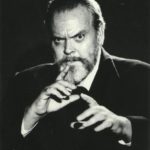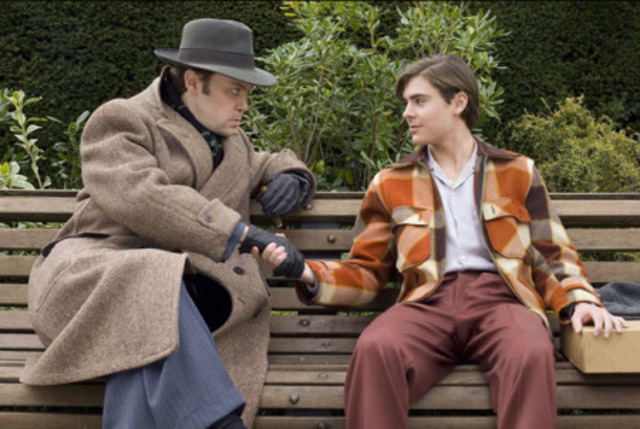
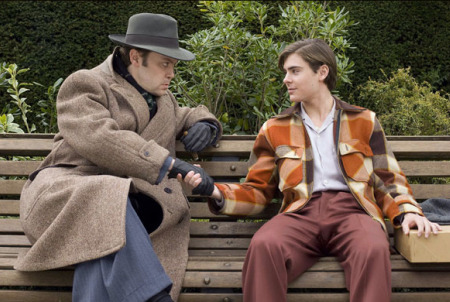
 Christian McKay, left, as a young Orson Welles, upstages dreamboat movie star Zac Efron.
Not long before seeing Me and Orson Welles, I had re-watched Welles’ exceptional film essay and final completed feature, 1974’s F for Fake, in which the director appears onscreen and on the soundtrack throughout the film. So as Richard Linklater’s new film began, Welles’ rich baritone, distinctive accent, and intense yet mischievous eyes were still lingering in my head. It came as a bit of a shock, then, when Christian McKay first appeared on screen with the exact same voice, eyes, and mannerisms as the great charlatan himself.
McKay’s performance as Welles is remarkable, and reason enough to see this thoroughly entertaining film, which concentrates on the groundbreaking production of Julius Caesar that he and his fledgling Mercury Theater embarked upon in 1937. Welles was only 22 at the time, already a prodigy, but still just at the cusp of the mega-stardom that the War of the Worlds broadcast would bring a year later, and that Citizen Kane would multiply the year after that. The film shies away from mentioning just how young Welles was here, mostly because no audience would ever buy that the 36-year-old McKay is quite that young. No matter; the actor captures the soul of Welles in a way that few portrayals of real people in the movies ever have. Even for film geeks who have pored over every bit of footage of the man, McKay’s performance rings flawless and true.
But let’s not get ahead of ourselves. There’s a “me” in the title of this film, after all, who must be an important figure if he’s sharing the title card with a giant. “Me” would be Richard, the fictional side of the film played by Zac Efron, a fresh-faced high school student who by sheer luck and good timing manages to score himself a small role in Caesar. The film, as with the Robert Kaplow novel on which it is based, is told from his perspective. His coming of age – artistically, in Welles’ chaotic production, and romantically, via an affair with a theater employee played by Claire Danes – is ostensibly the backbone of the story. But Welles was never one to fade into the shadows (well, rarely, anyway), and Welles the character quickly upstages Richard’s story just as surely as the dazzling McKay upstages the likable, but rather bland, Efron.