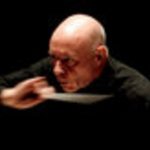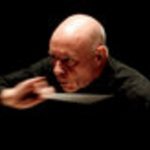
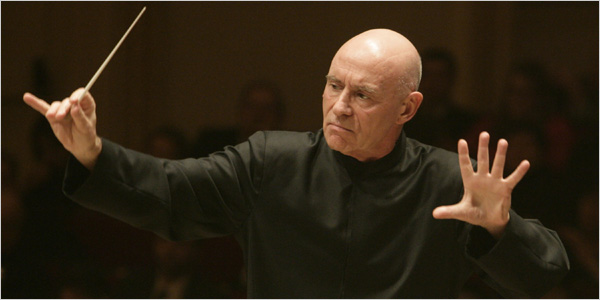
 Conductor Christoph Eschenbach
Christoph Eschenbach will begin his first season as music director of the National Symphony Orchestra next fall, and the programming he has planned is encouraging. In his only concerts with the hometown band between the announcement of his appointment and the beginning of his tenure, this past weekend, Eschenbach gave reasons both to hope and worry about what we can expect in the coming years. Giuseppe Verdi’s bombastic but intensely pious setting of the Latin Requiem Mass, performed with alarming frequency in Washington over the past few years, is sure to thrill a crowd, even if all of its surfaces are not perfectly polished. As heard at the final performance on Saturday night, Eschenbach’s rendition of this overexposed masterpiece excelled in the rip-roaring parts, but had a sort of enforced solemnity. This was thanks in part to the conductor’s long hold of the silence at the end of the piece, which as time passed went from being reverent to affected.
What was obviously in question was Eschenbach’s judgment as far as his quartet of vocal soloists. For the most part, Verdi simply transferred his understanding of operatic vocal demands to these parts, and the piece can succeed or fail on the power of these voices. Austrian tenor Nikolai Schukoff was the best, an earnest voice with resonance and power as well as control. Mezzo-soprano Mihoko Fujimura was mostly solid, although in some ways Verdi rests the dramatic weight of the first part of the work on the mezzo’s shoulders, demands especially at the top of her voice that Fujimura was not always able to meet. For all of the beauty of Evgeny Nikitin’s bass voice, with enough bluster and power to fill the Kennedy Center Concert Hall, one could only wish that he knew the part better. He tended to start many notes somewhere near the pitch in the score, generally below it, then scooped up to it.