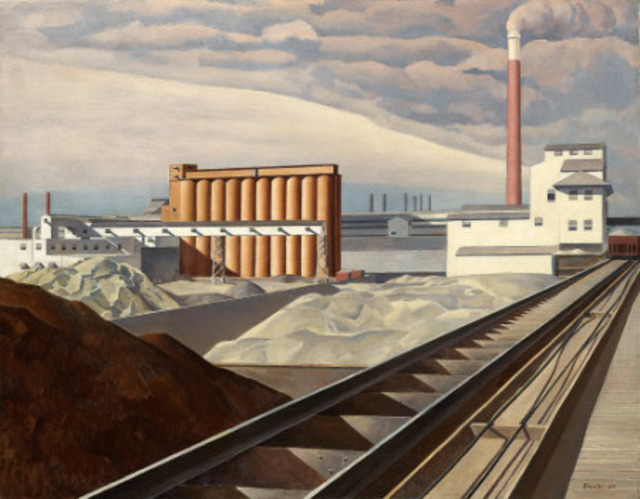
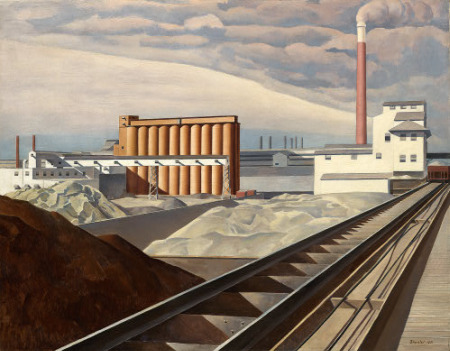
 Image of Charles Sheeler’s “Classic Landscape,” courtesy the National Gallery of Art
Written by Aleid Ford, who is profiling 365 masterworks at the National Gallery of Art this year for her project Art 2010, which appears on her website Head for Art.
In 1927, the American artist Charles Sheeler (1883 – 1965) was paid to photograph Ford Motor’s new River Rouge Plant near Detroit for the company’s advertising campaigns. During the course of the commission, he became so profoundly inspired by the subject (calling it “incomparably the most thrilling I have had to work with”), that he went on to paint several pictures of the plant.
Classic Landscape (1931) is utterly eye-catching for its distilled, clinical execution. It suggests beyond any shadow of a doubt that Sheeler’s twinned pursuits of painting and photography were stylistically symbiotic. Educated at the Pennsylvania School of Industrial Art and the Pennsylvania Academy of the Fine Arts, Sheeler dabbled at first in a loose, impressionistic style that he rejected quickly, in favor of the austere realism we see here.
Classic Landscape is painted with oil on canvas, but the finish is so smooth and the precision so pin-sharp, that the level of realism is confounding to the eye on first view. There’s the slick rail track shooting off on a diagonal into the scene, chugging the eye along with it, deep into the plant. The spatial recession is calculated and clean, with objects measured and meted out into space. Sharp shadows cut into the ground and across the buildings: on the one hand the shading adds realistic roundness to the 3D objects, but on the other it somehow doesn’t detract from the overall dazzling flatness of the scene.